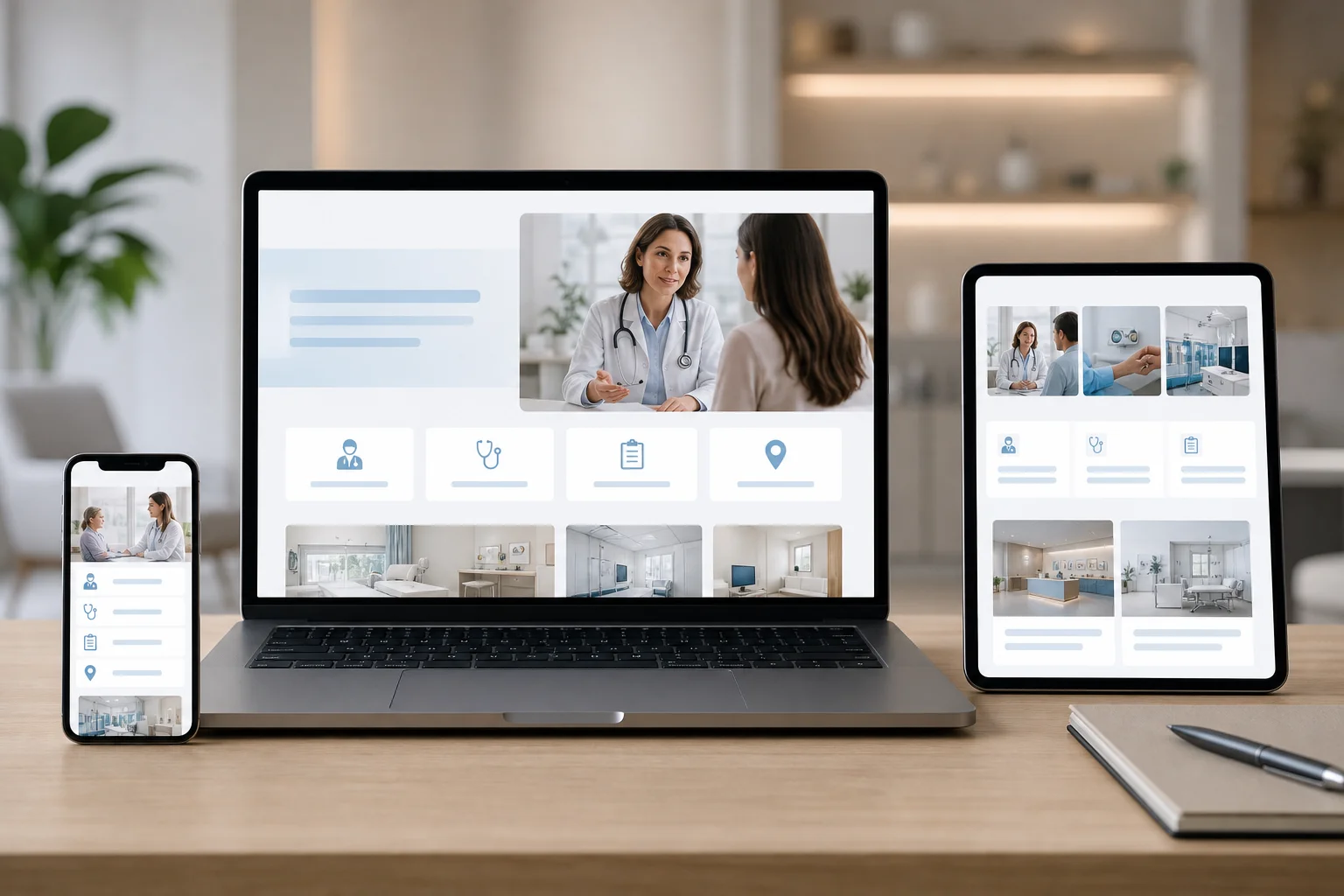
A doctor can have a strong Google Ads campaign, good reviews and years of medical experience, but there is still one place where the patient eventually wants to find more information: the doctor's website.
That visit can happen before the patient calls, after seeing a Google advertisement, after finding the practice on Maps or simply while comparing several doctors in the same specialty.
In those few minutes, the website has a simple job.
It should help the patient understand who the doctor is, what the doctor does, where the doctor consults and what the patient should do next.
From an SEO perspective, the website also needs to make those things clear to search engines.
This is why doctor website SEO is not simply about adding keywords to pages. The structure, content, technical foundation, internal links, local information and patient experience all need to work together.
A doctor's website should answer the patient's first questions quickly
Imagine that someone has searched for a cardiologist and has just opened your website.
They are unlikely to spend five minutes trying to understand what the website is about.
They want to know:
- Who is the doctor?
- What is the doctor's specialty?
- What conditions or services are handled?
- Where does the doctor consult?
- How can an appointment be made?
- Why should I consider this doctor?
These answers should be easy to find.
If a visitor has to search through several menus before finding the clinic address or appointment information, the website is making the patient's job unnecessarily difficult.
The homepage should introduce the practice, not contain everything
One common problem with medical websites is trying to make the homepage rank for every service the doctor provides.
The homepage should introduce the doctor or practice and guide visitors towards the most important parts of the website.
Individual services can then have their own useful pages where appropriate.
For example, a fertility specialist may have separate information around IVF, infertility treatment and fertility consultation. An orthopaedic doctor may have pages covering relevant conditions, procedures and consultations.
This gives both patients and search engines a clearer understanding of the website.
Every important service needs a useful page
A doctor should not create service pages simply because an SEO professional says that more URLs are better.
A page should exist because there is enough useful information to explain that service properly.
A good service page can explain:
- What the service is
- Who the service may be relevant to
- What the doctor provides
- Important questions patients commonly ask
- Where the consultation takes place
- How to contact the practice
The content should remain medically responsible and should not turn into a sales page full of exaggerated promises.
The doctor's profile page matters for both patients and search
Patients want to know who they are considering.
A doctor's profile should therefore go beyond simply displaying a name and qualification.
Where relevant and accurate, it can explain:
- Medical qualifications
- Specialty
- Professional experience
- Areas of clinical interest
- Hospitals or clinics where the doctor consults
- Professional memberships or achievements
- Languages spoken, where useful
- Consultation locations
The information should be factual and kept up to date.
Location should be obvious
A patient searching for a doctor is often making a local decision.
If your clinic is in South Kolkata, for example, the website should make the clinic's actual location clear rather than forcing visitors to search for the address.
Important location information can include:
- Clinic address
- Area or neighbourhood
- City
- Consultation hours
- Contact number
- Directions or map information
This information should also be consistent with the practice's Google Business Profile.
For a broader local search strategy, see our Local SEO for Doctors in Kolkata service.
Mobile experience is not optional
A patient may discover a doctor while using a phone and immediately open the website from Google.
If the page is difficult to read, buttons are too small, important information is hidden or the page takes too long to become usable, the visitor may simply leave.
A doctor's website should therefore be designed around mobile visitors rather than treating mobile as an afterthought.
Important actions such as calling the clinic, requesting an appointment or finding the clinic should be straightforward.
Website speed affects the patient experience
A beautiful medical website is not useful if it takes too long to load.
Large images, unnecessary scripts, excessive plugins, poorly optimised code and heavy third-party resources can all affect performance.
This is particularly important for a patient arriving from a mobile search.
Website performance should therefore be checked as part of technical SEO and not only after the site has already been published.
Clear appointment actions matter
One of the easiest mistakes on a doctor's website is making the visitor guess what to do next.
If the objective is to generate consultation enquiries, the website should provide a clear path towards that action.
Depending on the practice, this might include:
- Call the clinic
- Request an appointment
- Book a consultation
- Send an enquiry
- Find the clinic
The exact action should match the doctor's actual booking process.
There is little value in adding a large "Book Now" button if the clinic does not actually have a reliable booking process behind it.
Content should be written for patients, not search engines
A doctor website needs content, but more content is not automatically better.
Patients want clear answers to genuine questions.
They do not want to read the same keyword repeated throughout every paragraph.
A useful medical article might explain a condition, treatment or common question in straightforward language while making it clear when a professional consultation is appropriate.
The doctor should remain the source of clinical expertise. SEO should help patients discover useful information rather than turn medical content into a collection of search-engine phrases.
Medical content needs accuracy and responsibility
Healthcare websites require more care than many ordinary business websites.
A medical page should avoid unsupported claims, guaranteed outcomes and sensational statements about treatment.
Information should reflect the doctor's actual practice and should be reviewed when important clinical information changes.
A useful medical website should help a patient understand a subject without pretending that a website article can replace an individual medical assessment.
Internal links help create a logical website
A doctor website can have excellent individual pages and still have a weak structure if those pages are disconnected.
Internal links help visitors move naturally between related information.
For example, a medical article about a condition can link to the relevant treatment page. That treatment page can link to the doctor's specialty page, while the specialty page can lead visitors towards an appointment action.
This creates a clearer journey:
Information → Specialty → Service → Doctor → Appointment
Internal linking should be natural and useful rather than adding links simply to increase the number of links on a page.
Technical SEO is the part patients usually never see
A patient may never know whether a website has a good technical SEO foundation.
But search engines need to be able to discover, crawl and understand the important pages.
A technical review can include:
- Indexability
- Canonical URLs
- XML sitemap
- Robots.txt
- Internal linking
- Broken links
- Redirects
- Page speed
- Mobile usability
- HTTPS
- Structured data where appropriate
The purpose is not to make the website technically complicated. It is to remove unnecessary barriers between the website and search engines.
What about schema markup?
Structured data can help search engines understand certain information on a page when the implementation is appropriate.
Depending on the website, structured data may be relevant to information such as the organisation, person, medical practice or other supported content types.
But schema should not be treated as a shortcut to rankings.
Adding markup does not mean Google will automatically give the website a special search result or higher ranking.
The markup should accurately describe the visible and relevant information on the page.
Google Search Console should be part of the process
Once a doctor's website is live, the work should not end.
Google Search Console can provide useful information about how the website is appearing in Google Search.
It can help a site owner understand:
- Which searches are generating impressions
- Which queries generate clicks
- Which pages receive organic traffic
- Whether important pages are indexed
- Whether Google reports certain technical issues
This information can then influence future SEO work.
How the website supports Google Ads
A doctor's website is also important when running Google Ads.
An advertisement may bring someone to the website, but the landing page then has to continue the conversation.
If the advertisement promotes a particular service, the visitor should ideally arrive at a page that is clearly connected to that service.
Sending every advertisement to a generic homepage can make the patient journey less direct.
If paid acquisition is part of your strategy, you can explore our Google Ads for Doctors in Kolkata service.
SEO and website development should not be separated
One reason doctor websites often require SEO work after development is that SEO was considered only after the website had already been built.
A better approach is to consider the search structure while developing the website itself.
That means thinking about:
- Page hierarchy
- URL structure
- Service pages
- Doctor profiles
- Internal linking
- Mobile layout
- Page speed
- Conversion actions
- Local information
This is the thinking behind our Doctor Website Development in Kolkata service.
What should a doctor measure after launching the website?
A website should not be judged only by how attractive it looks.
A better evaluation includes both search performance and patient behaviour.
Depending on the practice, useful measurements can include:
- Organic impressions
- Organic clicks
- Important search queries
- Indexed pages
- Service-page visibility
- Phone enquiries
- Appointment requests
- Contact-form submissions
- Engagement with important pages
The goal is to understand whether the website is attracting the right people and helping them take the next step.
Common SEO mistakes on doctor websites
Many healthcare websites do not have one major SEO problem. Instead, several small problems work together.
Common examples include:
- A homepage trying to rank for every service
- Very thin service pages
- Almost identical location pages
- Missing or weak doctor information
- Poor mobile experience
- Slow-loading images
- Weak internal linking
- Unclear appointment actions
- Outdated clinic information
- Generic medical articles with little original value
- Broken or unnecessary redirects
- Important pages accidentally blocked from indexing
Fixing these fundamentals can be more useful than continually publishing new articles.
How medical SEO fits into the complete strategy
A doctor's website is the centre of several online channels.
Google Ads can send paid traffic to it. Organic SEO can send visitors from search results. Local SEO can connect patients with the practice through local search and Maps. Content can answer patient questions.
The website has to provide a consistent experience after each of those discovery paths.
That is why our Medical SEO for Doctors in Kolkata service focuses on the website as part of the broader search strategy rather than treating individual keywords as the entire objective.
What a doctor should expect from a properly planned website
A good medical website should not feel like an SEO project when a patient uses it.
It should simply feel clear.
The doctor is easy to understand. The services are easy to find. The clinic location is clear. The content answers useful questions. The website works on mobile. Contacting the practice does not require unnecessary effort.
Behind that simple experience, however, there should be a sensible technical and content structure that allows search engines to understand the practice.
How BrandOrbs approaches doctor website SEO
At BrandOrbs, we look at a doctor's website from two sides.
The first is the patient's experience: can the visitor understand the doctor, service, location and next step?
The second is the search foundation: can search engines crawl, understand and connect the important pages of the website?
That means website structure, content, internal links, technical SEO, local information, mobile experience and conversion actions need to work together.
For practices looking at the complete picture, our Doctor Digital Marketing services in Kolkata combine website, SEO, Local SEO and Google Ads around the actual needs of the practice.
Frequently Asked Questions
What is doctor website SEO?
Doctor website SEO is the process of improving the structure, content, technical foundation and search relevance of a medical website so that patients can more easily discover useful pages through search engines.
What pages should a doctor's website have?
The exact structure depends on the practice, but important websites commonly need a homepage, doctor profile, relevant specialty and service pages, contact/location information and useful patient-focused content.
Does a doctor need a separate page for every treatment?
Not necessarily. A separate page should have a genuine purpose and enough useful information to justify its existence. Creating many thin or nearly identical pages simply to target keywords can make the website repetitive.
Is website speed important for doctor SEO?
Website performance is important both for usability and for the overall quality of the website experience. Large images, unnecessary scripts and poorly optimised resources should be reviewed as part of technical website optimisation.
Can a doctor website rank without a blog?
A blog is not the only way to build organic visibility. Strong service pages, doctor information, specialty content, technical SEO and local relevance can all contribute to a website's search presence. Articles should be created when they provide useful information, not simply to increase the number of pages.
Conclusion: Build the website patients and search engines can understand
A doctor's website should never be built only for Google.
It should also never be built only to look impressive.
The strongest medical websites sit somewhere between the two. They give patients clear, useful information while providing search engines with a well-structured website that can be crawled and understood.
That means the doctor's expertise needs to be clear. Important services need useful pages. The clinic location needs to be easy to find. The website needs to work properly on mobile. Patients need a clear way to make contact. And the technical foundation should not create unnecessary barriers to search visibility.
Once those fundamentals are in place, SEO, Local SEO and Google Ads can work much more effectively because they are sending people to a website that is prepared to continue the conversation.
The real purpose of doctor website SEO is not simply to make a medical website rank. It is to make the right information easier to discover, easier to understand and easier for a potential patient to act on.
That is the foundation on which a sustainable doctor-focused digital presence can be built.