For years, SEO had a fairly predictable destination: get a page into Google's search results, improve its position, earn the click and turn that visitor into a lead or customer.
That model is changing.
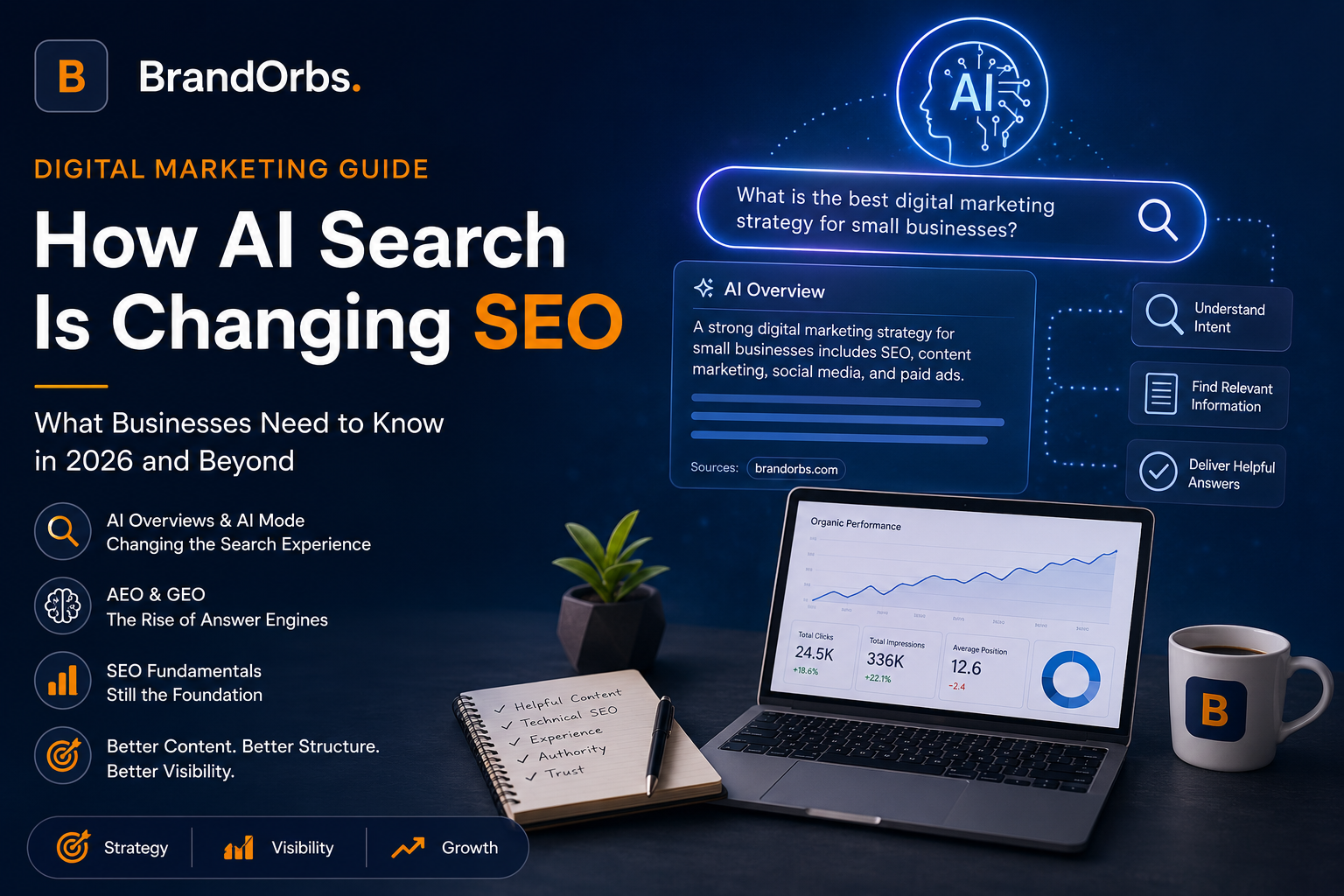
People are increasingly asking search engines questions in a conversational way and expecting an answer before they decide which websites to visit. Google has introduced AI-powered search experiences such as AI Overviews and AI Mode, while other platforms are also changing how people discover information, products, services and businesses.
But there is an important point that often gets lost in the discussion: AI search does not mean SEO is dead.
In fact, the fundamentals are becoming more important. Google currently states that its generative AI search features rely on its existing Search ranking and quality systems. In other words, a business cannot simply create a special "AI SEO" page and expect it to bypass the fundamentals of search visibility.
The bigger change is that ranking is no longer the only visibility objective. Businesses now need to think about whether their brand, expertise, services and information can be understood, selected and referenced across different search experiences.
What is actually changing in search?
Traditional Google search usually starts with a query and returns a collection of results. The user scans those results, chooses one and visits the website.
AI-assisted search can work differently.
A user may ask a broader question such as:
"What is the best digital marketing strategy for a small healthcare business in Kolkata?"
Instead of treating that sentence as one simple keyword, an AI-powered search experience can interpret the underlying intent, break the question into related concepts and use information from multiple sources to construct a response.
This creates a new visibility problem for businesses.
You are no longer competing only for: "Who ranks number one for this keyword?"
You are increasingly competing for: "Which businesses and sources does the search experience consider useful enough to surface, mention or recommend?"
AI Overviews and AI Mode do not replace traditional SEO
This is where a lot of confusion has entered the SEO industry.
You will find plenty of advice suggesting that businesses need an entirely new system called "AI SEO", or that traditional SEO should be abandoned in favour of AEO or GEO.
That is too simplistic.
Google's current documentation makes the relationship much clearer: its generative AI features use Google's Search systems and indexed web content. A page still needs to be discoverable and indexable, and established SEO practices remain relevant.
So the practical approach is not:
SEO OR AI SEO
It is:
Strong SEO + useful content + clear information + broader search visibility.
Then what are AEO and GEO?
Two terms that are now appearing frequently in the industry are AEO (Answer Engine Optimization) and GEO (Generative Engine Optimization).
They are useful concepts for describing the change in search behaviour, but they should not be treated as magic ranking systems.
AEO: Answer Engine Optimization
AEO generally focuses on making information easy for answer-oriented search experiences to understand and use.
For example, a business could structure its content around real questions customers ask:
- How much does SEO cost?
- How long does SEO take?
- Should a local business invest in Google Ads?
- What is the difference between SEO and Google Ads?
- How can a business improve Google Maps visibility?
The objective is not to stuff these questions onto a page. The objective is to answer them properly.
GEO: Generative Engine Optimization
GEO is generally used to describe efforts to improve the chances of a business or website being surfaced in generative AI experiences.
But this is where businesses should be careful.
There is no reliable shortcut where adding a particular phrase, special AI file or a prescribed number of mentions automatically makes a company appear in AI answers.
Google itself has specifically addressed several misconceptions around AEO and GEO and says website owners should focus on established SEO practices and genuinely useful, distinctive content rather than artificial "AI optimization" tricks.
What does AI search mean for a local business?
The impact could be particularly important for local businesses.
Imagine someone searching:
"Which digital marketing agency in Kolkata can help a healthcare business with SEO and Google Ads?"
That is a much more detailed question than: "digital marketing agency Kolkata".
A business that only has one generic service page may have difficulty demonstrating all the information needed to answer that broader question.
A stronger website might have:
- A detailed SEO service page
- A Google Ads service page
- A Local SEO service page
- Industry-specific case studies
- Useful pricing and process information
- Detailed answers to common customer questions
- Evidence of actual experience
- Clear company and contact information
Together, these pages create a much clearer picture of what the business actually does.
That is much more useful than trying to manufacture an "AI-friendly" page.
The biggest opportunity: become a useful source, not just another result
This is the part of AI search that I believe businesses should pay more attention to.
A lot of websites are built around the question:
"What keyword should I put on this page?"
A better question is:
"What does my potential customer need to know before choosing me?"
Those are not always the same thing.
Suppose you are a dental clinic. A page targeting "dentist in Kolkata" is useful, but it does not answer everything a potential patient may want to know.
The same person might also want to understand:
- When should I see a dentist?
- What does a root canal involve?
- How much does treatment usually cost?
- How long does treatment take?
- What should I ask before choosing a clinic?
Building useful resources around those decisions creates a much stronger information ecosystem than publishing dozens of thin keyword-targeted articles.
AI search makes content quality more important
This does not mean every page needs to be 3,000 words.
In fact, length by itself is a poor content strategy.
A 900-word page containing original experience, useful examples, clear explanations and specific information can be considerably more valuable than a 2,500-word article that repeats what is already available on hundreds of websites.
For businesses, original information can come from places such as:
- Real campaign experience
- Case studies
- Before-and-after examples
- Industry observations
- Pricing ranges and planning considerations
- Common customer questions
- Local market knowledge
- Original research and data
- Expert explanations
This is one reason we are putting more emphasis on case studies and practical resources at BrandOrbs instead of treating the blog as a place to publish generic keyword articles.
Why your website structure matters more than ever
AI search does not remove the need for a well-organised website.
It arguably makes the structure more important.
Consider a digital marketing agency with one page called "Digital Marketing Services." It may mention SEO, Google Ads, social media, websites and performance marketing in a few paragraphs.
Compare that with an agency that has dedicated service pages explaining each area in depth, supported by relevant articles and real case studies.
The second site gives both users and search systems a much clearer understanding of the business.
For example, our SEO service page can act as the main commercial page, while supporting resources can explain specific topics such as AI search, SEO pricing, SEO timelines and AEO/GEO.
That creates a connected content system rather than a collection of unrelated blog posts.
Internal linking becomes more valuable
One article should not have to explain everything.
Instead, a strong website can distribute information across a logical cluster.
For example:
Each page has a different purpose, but together they establish topical depth.
What should businesses actually do in 2026?
If you are a business owner, you do not need to rebuild your entire SEO strategy around the latest AI terminology.
I would start with these seven areas.
1. Fix the technical foundation
Make sure important pages can be crawled, indexed and accessed properly. Clean URLs, sensible internal linking, mobile usability, performance and correct indexing remain fundamental.
2. Build pages around real commercial intent
Do not rely entirely on informational blog traffic.
Build strong pages for the services, products, locations and problems that actually generate business.
3. Answer the questions customers ask before buying
Pricing, timelines, process, comparisons, limitations and expectations are often more useful than another generic "What is SEO?" article.
4. Add evidence
Show what you have actually done.
Case studies, examples, project explanations, original observations and measurable outcomes can make a website substantially more credible.
5. Build topical clusters
Instead of publishing random articles whenever a keyword appears in a tool, create groups of related content around your important services and customer problems.
6. Think beyond one keyword
Customers rarely use the exact same wording every time.
A person searching for an SEO agency may later search for SEO pricing, SEO timelines, local SEO, Google Maps visibility, SEO results or SEO vs Google Ads.
Your website should be useful across that entire decision journey.
7. Measure business outcomes, not only rankings
Rankings still matter, but they are not the final objective.
Track organic traffic, qualified enquiries, calls, form submissions, important landing pages and conversions alongside search visibility.
What about AI-generated content?
This is another area where businesses often take an extreme position.
The question should not simply be: "Was AI used to create this article?"
The more useful question is: "Does this article provide something worthwhile to the reader?"
Using software to assist with research, outlining or editing is very different from filling a website with hundreds of pages that say essentially the same thing.
Google's current guidance emphasises useful, unique content created for people and warns against attempts to manipulate generative AI search visibility. Google's spam policies also apply to content intended to manipulate generative AI responses.
AI search will change the click — not eliminate the website
One concern is that AI-generated answers will simply take all website traffic away.
That is too early and too absolute a conclusion.
Some searches may be satisfied without a click. Others will still require a user to visit a website because they want to compare services, check prices, read detailed information, see products, make an enquiry or contact a business.
In many commercial searches, the website remains where the actual business transaction happens.
That means the objective should not be to chase clicks at any cost. It should be to make your brand visible throughout the research journey and give the visitor a strong reason to choose you when they reach your website.
How BrandOrbs approaches AI-era SEO
At BrandOrbs, we do not see AI search as a reason to throw away conventional SEO and replace it with a collection of new acronyms.
Our approach starts with the business.
We look at what the company sells, who it wants to reach, what customers search for, which searches indicate buying intent and what information customers need before making a decision.
From there, the strategy can combine:
- Technical SEO
- Commercial landing pages
- Local SEO where relevant
- Helpful supporting content
- Internal linking and topic clusters
- Case studies and original evidence
- Conversion-focused website improvements
- Measurement of leads and business outcomes
The objective is simple: build a website that deserves to be found, understood and chosen.
Frequently Asked Questions
Is SEO dead because of AI search?
No. AI search is changing how search results are presented, but SEO remains important. Google's own documentation says its generative AI search features are built on its core Search ranking and quality systems.
Do I need a separate GEO strategy?
Not necessarily. GEO can be useful as a way to describe visibility in generative search, but there is no universal GEO shortcut that replaces SEO. Strong technical foundations, useful content, clear site structure and real expertise remain the better starting point.
Should I create an llms.txt file for AI search?
Do not treat it as a Google ranking requirement. Google's current AI search guidance says that an llms.txt file is not required for visibility in Google Search's generative AI features.
Will AI search reduce website traffic?
It can change how and when people click through to websites, particularly for searches that can be answered directly. However, commercial research, comparisons, transactions, service enquiries and detailed investigations can still require a website visit.
What should a small business do first?
Start with the fundamentals: make sure your important pages are technically accessible, create strong service and location pages, answer genuine customer questions, demonstrate experience and connect related content through internal links.
The real SEO advantage in an AI-first search environment
The biggest opportunity is not finding a secret way to "hack" AI search.
It is building a business website that is genuinely more useful than the alternatives.
If your website clearly explains what you do, demonstrates that you know your subject, answers difficult customer questions, provides original information and connects visitors to the right commercial pages, you are building an asset that can work across multiple forms of search.
That is the direction SEO is heading.
Not SEO versus AI search.
SEO for a search environment that is becoming increasingly intelligent, conversational and competitive.
Want to know where your website stands?
BrandOrbs can review your current organic visibility, website structure, content opportunities and commercial search presence.
Get a Free Growth Audit →