How to Get Quality Leads from Google Ads in 2027: A Practical Guide
Getting more leads from Google Ads is not the same as getting better leads. A campaign can produce a healthy-looking number of form submissions while the sales team spends its time dealing with people outside the service area, looking for free advice, comparing prices without buying intent, or asking for a service the business does not provide.
The real objective is to create a reliable connection between four points: what a person searches for, what the advertisement promises, what the landing page asks them to do, and what happens after the enquiry enters the business.
If one of those links is weak, the account may optimise for cheap conversions rather than commercially useful opportunities.
This guide explains how to get quality leads from Google Ads in 2027 without treating lead volume as the main success measure. The principles can be applied to local businesses, clinics, professional firms, B2B companies, e-commerce businesses and other organisations where a lead needs to be evaluated before it becomes a customer.
What Is a Quality Lead in Google Ads?
A quality lead is not simply somebody who fills out a form. A useful lead should match the business's target customer and have a genuine requirement for the product or service being offered.
For example, imagine a Kolkata digital marketing agency receives 50 enquiries from Google Ads. On paper, 50 leads may look like a good result. But if 20 people are asking for free services, 10 are outside the service area, 8 are looking for jobs or training, and only 12 are genuine prospects, the campaign has not really produced 50 valuable opportunities.
It has produced 12 potentially useful opportunities.
Before changing keywords or increasing the budget, define what a qualified lead means for your business. A useful definition may include:
- The prospect needs a service the business actually provides.
- The person or organisation is within the relevant service area.
- The enquiry has reasonable commercial potential.
- The prospect has a realistic timeframe for taking action.
- The contact details are genuine and the person can be reached.
- The enquiry has reached a meaningful stage such as a consultation, quotation request or sales opportunity.
The definition will differ between industries. A dental clinic may care about a booked consultation and treatment suitability. A web development company may care about project scope, budget and decision-maker access. A local home-service company may care about postcode, urgency and job type.
Define the Lead Journey Before Optimising Google Ads
A simple lead-generation funnel can look like this:
- Raw lead — form submission, call or enquiry.
- Valid lead — genuine and reachable contact with a relevant request.
- Qualified lead — matches the business's service, location and commercial criteria.
- Sales opportunity — progresses to consultation, quotation or another defined sales stage.
- Customer — produces revenue or another commercially meaningful outcome.
The mistake is treating every stage as equally valuable. A form submission and a closed customer are not the same conversion.
Google Ads now provides separate Qualified lead and Converted lead conversion goals for advertisers that use offline conversion information. These goals are designed to connect Google-generated leads with later stages of the sales process.
Learn more about qualified and converted leads in Google Ads .
1. Start With Search Intent, Not a Long Keyword List
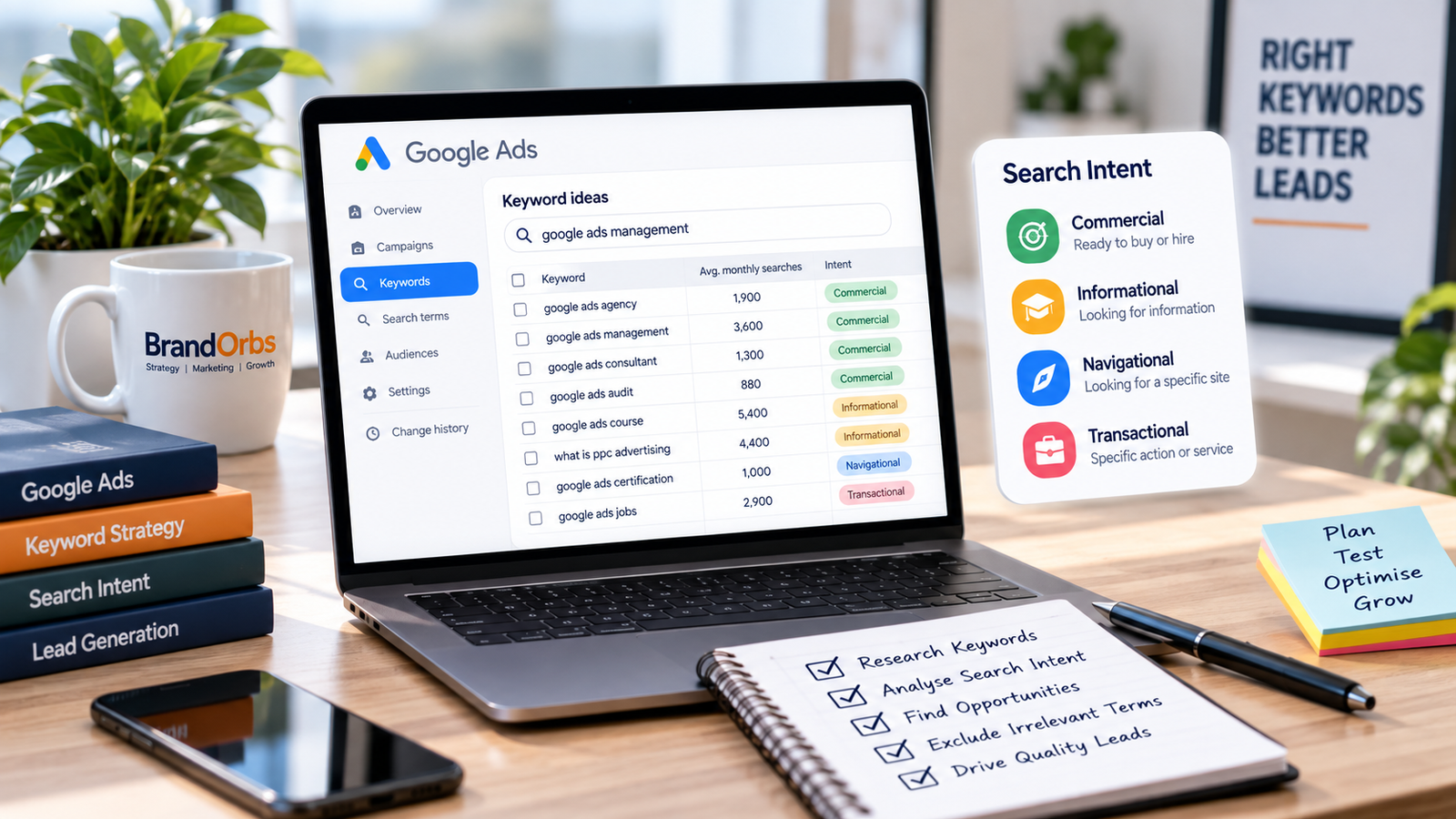
Keyword research should answer one important question: What is the person trying to accomplish right now?
Consider these searches:
| Search | Likely intent | Lead potential |
|---|---|---|
| what is PPC advertising | Educational | Low for immediate lead generation |
| Google Ads course | Training | Usually irrelevant for an agency |
| Google Ads freelancer for small business | Service investigation | Potentially relevant |
| Google Ads management agency Kolkata | Local commercial | High potential |
| Google Ads audit for existing account | Specific service | High potential |
A campaign focused on lead generation should normally give priority to searches indicating that someone wants a provider, quotation, consultation, management service or solution to an immediate business problem.
Informational searches can still have value for SEO, remarketing or audience development, but they should not automatically receive the same advertising budget as high-intent searches.
2. Choose Keywords for Commercial Fit, Not Just Traffic
A keyword can generate clicks without generating commercially useful enquiries. That is why search volume should not be the only factor used to select keywords.
Build keyword groups around a clear customer need. For example, a Google Ads management campaign could have separate themes for:
- Google Ads management
- Google Ads agency
- PPC management
- Google Ads audit
- Local Google Ads management
Avoid putting completely different intentions into one group simply because they contain similar words. Courses, jobs, software, free templates and agency services may all contain the words "Google Ads", but they represent different audiences.
A useful commercial calculation is:
Expected value per lead = lead-to-customer rate × average gross profit per customer
For example, a keyword that generates inexpensive enquiries may be less valuable than a more expensive keyword if the second keyword consistently produces prospects who become customers. Use the business's own data wherever possible rather than relying entirely on generic industry benchmarks.
3. Use Negative Keywords as a Quality-Control System
Negative keywords are not something you add once and forget. They should evolve from the actual search terms appearing in the account.
Depending on the business, unwanted themes may include:
- Jobs and careers
- Salary information
- Courses and training
- Free services
- DIY resources
- Templates
- Internships
- Unrelated locations
- Unrelated meanings of an ambiguous keyword
However, do not add negative keywords blindly. A term that is unsuitable for one business may be commercially useful for another.
For example, "cheap website design" may be an appropriate search for a budget web designer but unsuitable for an agency that only accepts larger projects. The correct response may be to test that search separately with qualifying messaging rather than automatically excluding it.
Review the search terms report regularly and look for patterns, not just individual queries.
4. Structure Campaigns Around Business Decisions
Campaign structure should make performance easier to understand and act on. It should not exist simply to create dozens of campaigns and ad groups.
A practical structure may separate:
- Different services with different economics
- Core service searches from branded searches
- Different locations where economics or service availability differ
- High-intent searches from experimental themes
- Acquisition campaigns from remarketing activity where appropriate
Do not split campaigns simply because two keywords use different adjectives. Split them when they need different budgets, landing pages, locations, conversion goals, bidding approaches or business responses.
5. Write Ads That Qualify the Visitor
A good advertisement does more than attract clicks. It should help the right prospect recognise that the offer is relevant and give the wrong prospect a reason to reconsider clicking.
Useful qualification information can include:
- The service category
- The location served
- The type of business accepted
- The project type
- The consultation or quotation process
- A minimum project scope where appropriate
For example, if an agency mainly works with established businesses that already have a website, an advertisement communicating that focus may qualify traffic better than a vague promise such as "Get More Leads Fast."
The advertisement must remain accurate. Do not use unsupported guarantees, artificial urgency or unrealistic performance claims simply to increase click-through rate.
6. Match the Landing Page to the Search
Someone searching for:
Google Ads agency in Kolkata
should not necessarily be sent to a generic homepage containing ten unrelated services.
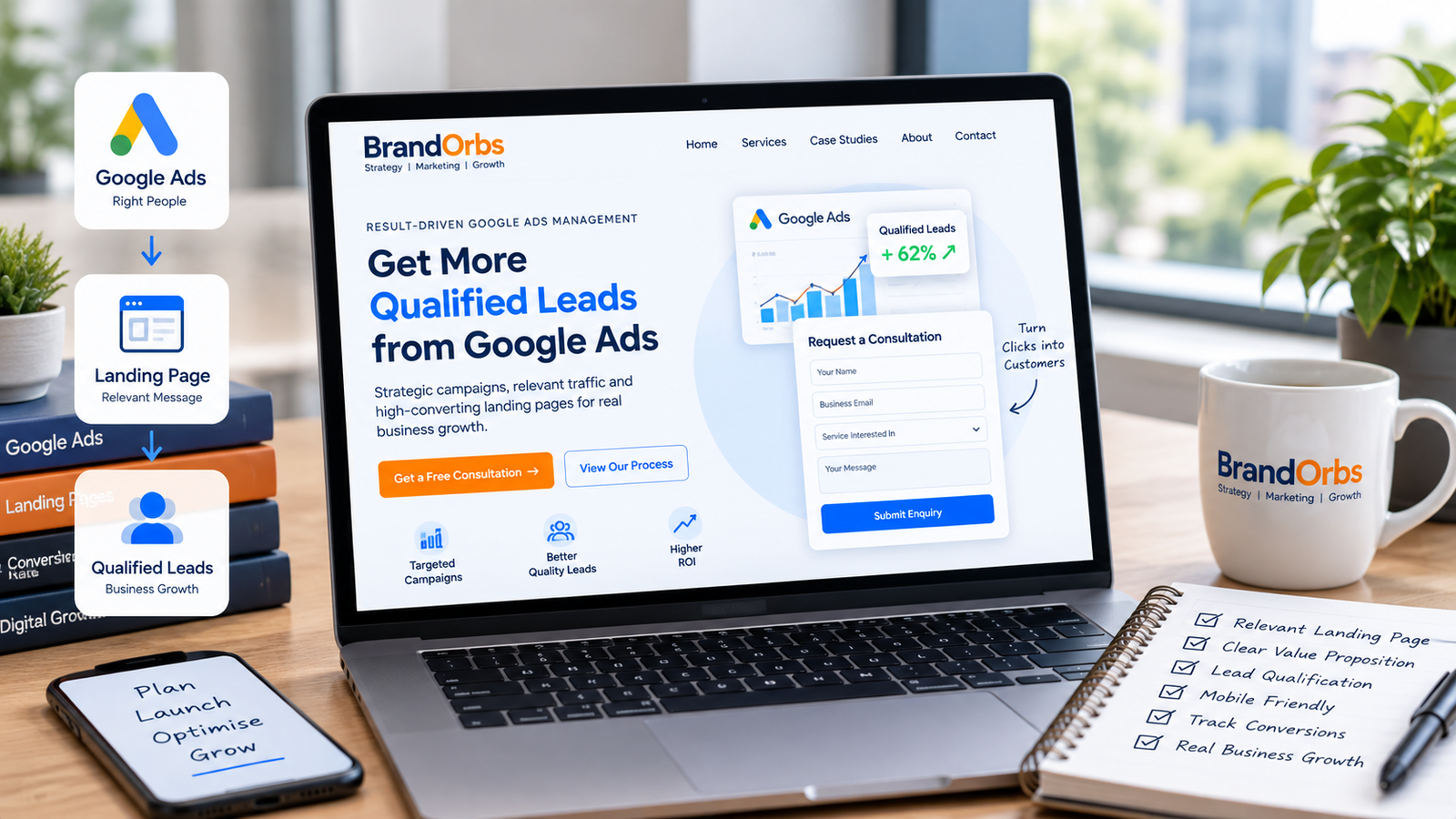
A dedicated Google Ads landing page can continue the same conversation started by the search and advertisement.
A strong landing page should explain:
- What service is being offered.
- Who the service is designed for.
- Which problems the service addresses.
- What the process looks like.
- What happens after the visitor submits an enquiry.
- What evidence or experience supports the offer.
- How the visitor can contact the business.
For businesses that need a stronger website or dedicated landing page before increasing advertising spend, BrandOrbs also provides web development services.
7. Let the Landing Page Help Qualify Leads
A landing page does not need to maximise form submissions at any cost. Sometimes a slightly more detailed form can produce better information for the sales team.
Depending on the business, useful questions may include:
- Which service are you interested in?
- What is your business website?
- Which location do you serve?
- What is your approximate monthly marketing budget?
- When are you planning to start?
Do not add unnecessary questions. Every extra field can create friction. Keep the questions that actually help determine eligibility, routing or sales priority.
Google also provides qualifying responses for eligible Search lead forms, allowing advertisers to use questions about needs, interests or purchase readiness to identify qualifying submissions.
Read Google's documentation on qualifying responses in lead forms .
8. Track More Than Form Submissions
A form submission is only the beginning of the sales process. For many businesses, the valuable event happens later.
Depending on the business model, track meaningful actions such as:
- Qualified forms
- Phone calls
- Booked appointments
- Consultations
- Quotation requests
- Sales opportunities
- Closed customers
Separate primary conversions from secondary interactions. A page view, button click or scroll event may be useful for analysis, but it should not automatically be treated as a lead.
If every small interaction is counted as a conversion, the advertising system receives a distorted picture of what success actually means.
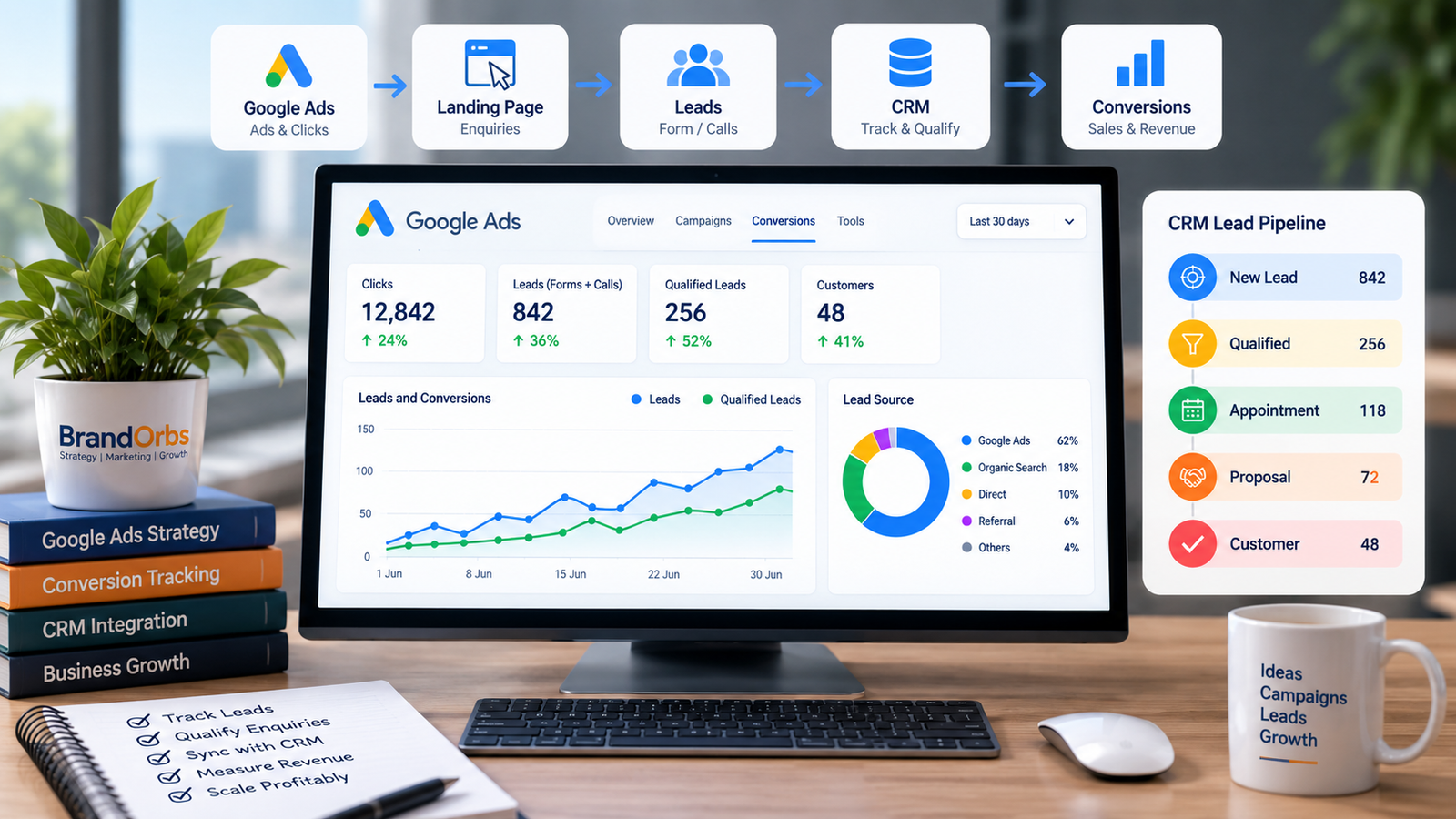
9. Connect Google Ads With CRM and Offline Conversion Data
This is where a basic lead-generation account can become a much more useful measurement system.
Imagine two campaigns:
| Campaign | Leads | Average CPL | Qualified leads |
|---|---|---|---|
| Campaign A | 100 | ₹400 | 10 |
| Campaign B | 60 | ₹650 | 25 |
Looking only at CPL makes Campaign A look cheaper. Looking at qualified opportunities gives the business a different piece of information.
The right measurement framework should therefore connect advertising data with the sales process. That may include:
- Lead source
- Campaign
- Search theme where available
- Landing page
- Lead status
- Qualification reason
- Sales opportunity
- Final outcome
Google's current documentation provides separate Qualified lead and Converted lead conversion goals for connecting Google-generated leads with later offline stages.
See Google's qualified-lead and converted-lead documentation .
10. Use Enhanced Conversions for Leads Where Appropriate
For businesses that receive enquiries online and then qualify or close those enquiries offline, enhanced conversions for leads can help connect first-party customer information with imported offline conversion data.
Google explains that enhanced conversions for leads can use hashed first-party information such as email addresses or phone numbers to improve the matching of offline conversion data with Google Ads interactions.
This can be useful when the real business outcome occurs after the original website enquiry.
However, implementation should be done carefully. The website, CRM, consent process, tagging and imported data all need to be configured correctly.
Google's documentation on Enhanced Conversions for Leads explains the current approach and implementation requirements.
11. Don't Optimise Only for the Cheapest CPL
Cost per lead is useful, but it is not the complete performance picture.
A campaign generating leads at ₹400 each may look better than one generating leads at ₹650. But if the ₹400 leads rarely become customers while the ₹650 leads regularly become sales opportunities, the cheaper CPL is not necessarily producing the stronger business outcome.
Track:
- Cost per lead
- Cost per qualified lead
- Qualified lead rate
- Appointment rate
- Sales opportunity rate
- Customer conversion rate
- Cost per customer
- Revenue or gross profit where measurable
The exact KPI hierarchy depends on the business model and sales cycle.
12. Review Search Terms Regularly
The keyword you add to Google Ads is not the entire story. The actual search terms triggering the advertisements can reveal how the campaign is behaving.
Search-term analysis can identify:
- Irrelevant queries
- Unexpected high-intent searches
- New keyword opportunities
- Queries that deserve their own ad group
- Terms that should be excluded
- Different language customers use to describe the same problem
This is one of the areas where ongoing campaign management can add value. A campaign should evolve from its own search and conversion data rather than being left unchanged for months.
13. Don't Make Too Many Changes at Once
Changing keywords, bids, budget, landing pages, advertisements and conversion goals at the same time makes it difficult to understand what caused the result.
A more controlled approach is:
- Identify the biggest performance problem.
- Develop a specific hypothesis.
- Make a focused change.
- Allow enough time for meaningful data.
- Compare the relevant business outcome.
- Keep or reverse the change based on evidence.
This becomes particularly important for campaigns with longer sales cycles. A lead generated today may not become a customer for several weeks.
14. Google Ads for Kolkata Businesses: Location Quality Matters
For a local business, getting enquiries from outside the service area can quickly reduce the practical value of a campaign.
A Kolkata-focused campaign may eventually evaluate areas such as:
- Kolkata
- Salt Lake
- New Town
- Rajarhat
- South Kolkata
- North Kolkata
- Howrah
- Dum Dum
- Garia
- Behala
However, location expansion should be based on actual business demand and conversion data. Creating many location targets does not automatically improve lead quality.
For BrandOrbs, this is particularly relevant because the objective is not simply to generate traffic from Kolkata. The objective is to generate enquiries from businesses that can actually use the service.
15. Calls Can Be Valuable Leads
Local businesses often focus heavily on website forms and overlook phone enquiries. For some services, a qualified phone conversation may be more valuable than a form submission.
Where calls are important, track them separately and evaluate:
- Number of calls
- Call duration
- Qualified calls
- Appointments generated
- Customers generated from calls
Google also provides call-related advertising assets and conversion measurement options. The important point is to measure whether calls actually contribute to the sales process.
16. Use Automation Only After the Data Is Reliable
Google Ads automation can process large amounts of data, but the quality of the input still matters. If the account treats every low-value form submission as a successful conversion, automated optimisation can receive the wrong signal.
Before increasing automation, establish:
- Accurate conversion definitions
- Reliable lead-status data
- Correct location targeting
- Search-term monitoring
- Negative-keyword controls
- A suitable observation period for the sales cycle
Automation should support a well-defined strategy rather than replace one.
17. Build a Lead-Quality Feedback Loop
A mature lead-generation system should look like this:
Search → Advertisement → Landing Page → Lead → Qualification → Sales Opportunity → Customer → Data → Optimisation
The important step is the final one. The outcome of the sales process should influence future advertising decisions.
Every month, ask:
- Which campaigns generated qualified enquiries?
- Which search themes produced customers?
- Which locations generated better prospects?
- Which landing pages produced useful opportunities?
- Which search terms produced poor-quality enquiries?
- Where is the sales team losing opportunities?
18. A Practical 30-Day Google Ads Quality Review
If the campaign is generating poor-quality leads, do not automatically increase the budget or change the bidding strategy. Start with the data.
- Audit the lead pipeline: classify recent enquiries as invalid, relevant, qualified, opportunity or customer where possible.
- Review search terms: identify irrelevant intent, ambiguous searches and location problems.
- Improve exclusions: add negative keywords carefully and separate experimental themes.
- Check ad-to-page alignment: make sure each major search theme reaches an appropriate offer.
- Review the form: remove unnecessary friction while keeping useful qualification questions.
- Validate conversion tracking: test forms, calls, CRM information and offline conversion events.
- Compare qualified outcomes: look beyond the cheapest CPL and evaluate the opportunities that actually matter to the business.
19. How BrandOrbs Approaches Google Ads Lead Generation
Google Ads should not be treated simply as a way of purchasing website traffic. For a lead-generation business, the campaign, landing page, tracking system and sales process should work together.
BrandOrbs can structure Google Ads campaigns around:
- Search-intent research
- Campaign and keyword structure
- Negative keyword management
- Location targeting
- Ad messaging
- Landing-page relevance
- Conversion tracking
- Lead qualification
- Search-term analysis
- CRM and lead-quality feedback
For businesses that want to improve both paid acquisition and organic visibility, BrandOrbs also provides SEO services.
The appropriate Google Ads strategy depends on the business, location, sales cycle, budget, competition and ability to handle incoming enquiries.
What Quality Lead Generation Should Look Like in 2027
The important shift is from lead volume to lead quality.
A campaign should not be judged only by how many form submissions appear inside the Google Ads account. The more useful questions are:
- How many leads were actually relevant?
- How many were qualified?
- How many became sales opportunities?
- How many became customers?
- What did those customers contribute to the business?
The practical process is straightforward: define the qualified lead, select commercially relevant search themes, control irrelevant traffic, write accurate ads, build relevant landing pages, measure the complete customer journey and feed reliable outcome data back into the advertising system.
When those pieces work together, the campaign can be evaluated on the outcomes that matter rather than on a single headline number such as CPL.
Google Ads Quality Lead Checklist
- Define exactly what a qualified lead means.
- Separate raw leads from qualified opportunities.
- Target commercial search intent.
- Review actual search terms.
- Maintain negative keywords.
- Write advertisements that accurately describe the offer.
- Use relevant landing pages.
- Ask useful qualifying questions.
- Track calls and forms.
- Connect CRM outcomes where technically appropriate.
- Use Qualified lead and Converted lead goals where appropriate.
- Evaluate cost per qualified lead, not only CPL.
- Compare campaigns using actual business outcomes.
- Review location and service-area performance.
Conclusions
The goal of Google Ads lead generation is not simply to generate more enquiries. It is to create a predictable connection between the searcher's intent and the business's sales process.
A campaign that generates fewer enquiries but produces substantially more qualified opportunities can be more useful than a campaign producing a large volume of inexpensive leads.
For that reason, businesses should look beyond: "How many leads did Google Ads generate?"
Instead, ask: "How many of those leads were qualified, how many became customers, and what did they contribute to the business?"
If you want to review whether your Google Ads campaign is attracting the right prospects, BrandOrbs can assess the campaign structure, search terms, conversion tracking and landing-page journey.