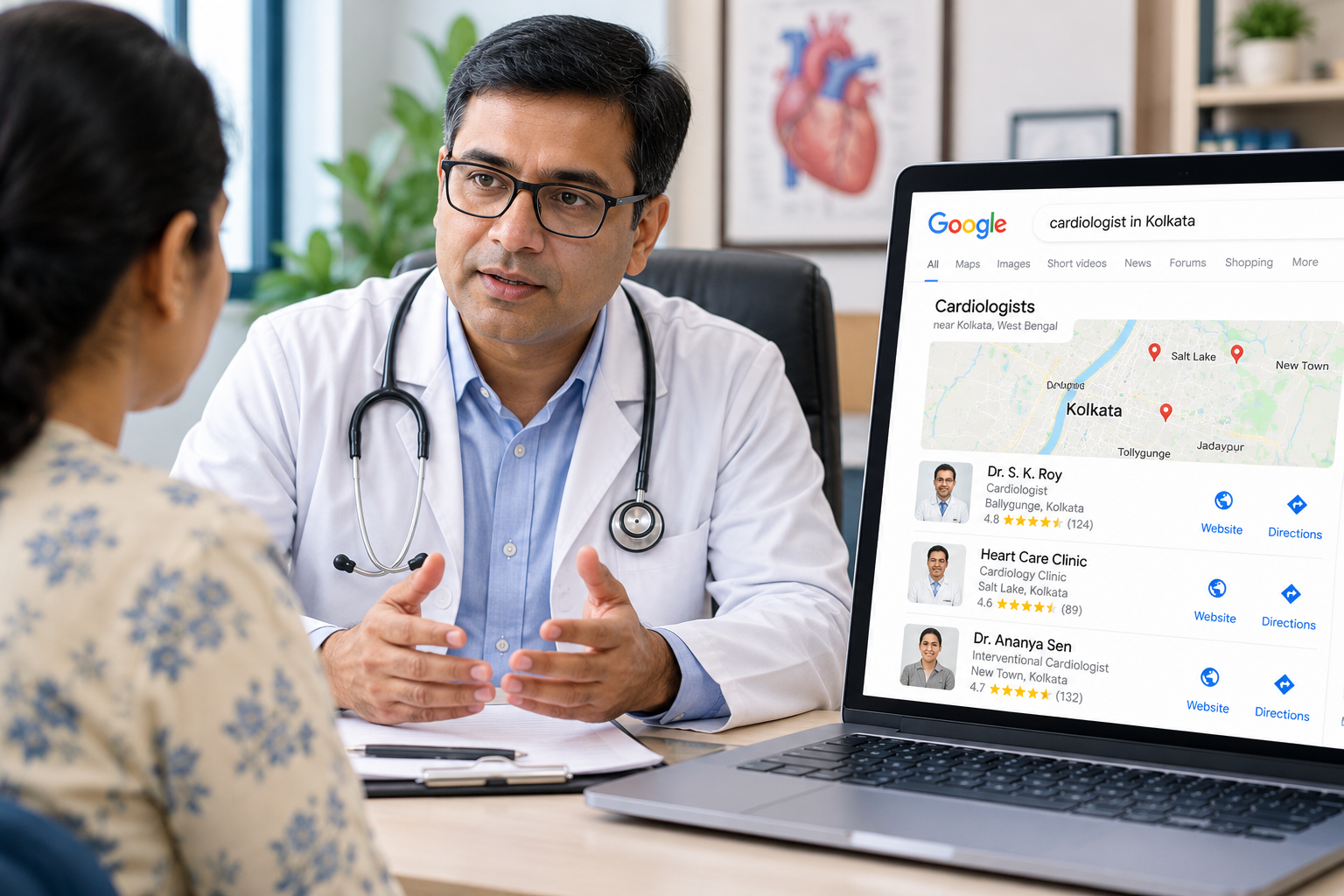
A patient looking for a doctor in Kolkata does not always search for the doctor's name. Quite often, the search starts with a problem, a treatment, a medical specialty or a location.
Someone may search for a cardiologist in Kolkata. Another person may search for a fertility specialist near them. Someone with persistent knee pain may search for an orthopaedic doctor, while another patient may search specifically for a clinic around Salt Lake, New Town, Mukundapur or Garia.
This is where medical SEO becomes important.
Medical SEO is not simply about putting the word "doctor" repeatedly on a website. It is about making the doctor's website useful, understandable and relevant to the searches that potential patients actually make.
How does a patient actually find a doctor on Google?
There is rarely one single search journey.
A patient may begin with a symptom, move to a treatment search, then look for a specialist and finally search for a doctor or clinic in a particular area.
For example, a patient could move through searches such as:
- "knee pain doctor in Kolkata"
- "orthopaedic doctor for knee pain"
- "best orthopaedic doctor near me"
- "orthopaedic doctor in South Kolkata"
- "Dr [name] Kolkata"
These searches represent different stages of intent.
A medical website that only has a homepage saying "Welcome to our clinic" may not give Google enough useful information about all the services and subjects the practice covers.
A stronger website gives important services, specialties, doctor information and locations their own useful pages where appropriate.
Medical SEO starts with the doctor's actual services
Before thinking about keywords, I would first look at what the doctor actually wants to be known for.
A cardiologist may want visibility around cardiac consultation, heart-related conditions, preventive cardiology and specific procedures.
A fertility specialist may have completely different search demand around IVF, infertility treatment, fertility consultation and reproductive health.
A dermatologist may need pages covering acne, hair loss, pigmentation, cosmetic dermatology and other relevant services.
The SEO strategy should reflect the real medical practice rather than creating pages simply because a keyword has search volume.
Why a doctor's homepage cannot do everything
One of the common problems I see with healthcare websites is trying to make the homepage rank for every service.
A homepage has an important role. It introduces the doctor or clinic, explains the practice and directs visitors to important areas of the website.
But a patient searching for a specific service may need much more detailed information than the homepage can reasonably provide.
A dedicated service page can explain the treatment, who it may be relevant to, what the doctor provides, where the service is available and how the patient can take the next step.
This also gives search engines a clearer understanding of what that particular page is about.
Location matters enormously for doctors in Kolkata
Medical searches are often local.
A patient may not simply want a cardiologist. They may want a cardiologist they can realistically visit in Kolkata.
Depending on the practice, searches can include areas such as Salt Lake, New Town, Rajarhat, Garia, Jadavpur, Tollygunge, Behala, Ballygunge, Mukundapur, EM Bypass and other parts of Kolkata.
This does not mean creating dozens of almost identical pages for every neighbourhood.
Location-focused content should have a genuine reason to exist and should provide useful information for people in that area.
A doctor with a strong local presence should also make the practice's real location, contact information and relevant business details clear.
Google Maps is part of the patient's search journey
Organic search is only one part of local discovery.
When someone searches for a doctor or clinic locally, Google Maps and local business information can become important parts of the decision-making process.
This is why a doctor's website should not be treated separately from the practice's local search presence.
Your website, Google Business Profile, clinic information, reviews and local signals should present a consistent picture of the practice.
If local visibility is an important part of your patient acquisition strategy, you can explore our Local SEO for Doctors in Kolkata service.
What does a medical SEO specialist actually work on?
Medical SEO is much broader than adding keywords to a page.
A proper SEO process can involve:
- Understanding the doctor's specialties and services
- Researching relevant patient search behaviour
- Improving important service pages
- Creating useful supporting content
- Improving page titles and descriptions
- Strengthening internal linking
- Improving website structure
- Checking technical SEO issues
- Improving mobile usability
- Reviewing page speed and overall page experience
- Strengthening local search signals
- Monitoring Google Search Console data
- Reviewing which queries and pages are generating visibility
The exact work depends on the website. There is no reason to make technical changes simply because they appear on a generic SEO checklist.
Why content matters for medical SEO
A doctor does not need hundreds of blog posts just to make a website look active.
What matters is whether the content answers questions that potential patients genuinely have.
For example, a gastroenterologist may publish useful information around symptoms, diagnosis, treatment options and when a consultation may be appropriate.
A gynaecologist may create useful content around common concerns, treatments and questions patients frequently ask before booking an appointment.
The doctor should remain at the centre of the content. The objective is not to write generic articles simply to insert keywords.
Medical content needs a different approach
Healthcare is a subject where careless content can create real problems.
A medical article should not make unsupported promises, present a diagnosis from limited information or make every treatment sound suitable for everyone.
Good healthcare content should explain information clearly while recognising that individual medical decisions require appropriate professional assessment.
For a doctor's website, this is also an opportunity to demonstrate genuine expertise rather than producing large volumes of generic SEO content.
Why internal linking matters on a doctor's website
Imagine a patient reading an article about a particular medical condition. The next useful step might be to learn about the doctor's relevant specialty or consultation service.
A contextual internal link can help the visitor move naturally from information to the relevant service page.
It also helps create a clearer relationship between different pages on the website.
For example, a medical article about a particular treatment can link to the relevant doctor service page. That service page can link back to the doctor's main specialty page.
This creates a useful content structure instead of leaving individual blog posts disconnected from the main website.
What about the doctor's website itself?
SEO cannot compensate for a website that is difficult to use.
A patient arriving from Google should be able to understand within a few seconds who the doctor is, what the doctor treats, where the consultation happens and how to make contact.
The website should also work properly on mobile devices because a significant amount of local search activity happens on phones.
Page experience matters as well. Google recommends considering factors such as Core Web Vitals, mobile usability, secure delivery and avoiding intrusive elements that interfere with the main content.
If the website itself needs a stronger SEO-ready structure, see our Doctor Website Development in Kolkata service.
How long does medical SEO take?
SEO is not an instant advertising system.
A new or weak website may need time for Google to crawl pages, understand the website and observe the quality and relevance of its content.
Existing websites can sometimes have a different starting point because they may already have indexed pages, search visibility, backlinks, branded searches and historical performance.
This is why I would avoid giving a doctor an artificial promise such as "you will rank in 30 days".
A more useful approach is to establish a baseline and monitor progress over time.
What should a doctor measure?
Rankings are useful, but they are not the entire story.
A medical SEO report should help answer practical questions:
- Which search queries are generating impressions?
- Which pages are receiving organic clicks?
- Which services are gaining visibility?
- Are local searches improving?
- Which pages are attracting potential patients?
- Are important pages indexed?
- Are technical problems affecting crawling or usability?
- Are organic visitors taking meaningful actions?
Google Search Console can be particularly useful for understanding how a website is appearing in Google Search and which queries and pages are generating search activity.
Medical SEO versus Google Ads
SEO and Google Ads should not be treated as identical services.
Google Ads provides paid visibility and can put a doctor in front of people searching for relevant services when the campaign is active.
SEO works differently. It focuses on building the website's organic search visibility over time.
For some practices, using both can make sense.
Google Ads can capture immediate search demand while SEO builds a broader organic presence around the doctor's specialty, services and location.
We explain the paid side separately in our Google Ads for Doctors in Kolkata service.
Does a doctor need a separate page for every treatment?
Not necessarily.
The website structure should reflect the real services and the amount of useful information available for each subject.
Creating dozens of thin pages with only the doctor's name, service and city changed on each page can make a website repetitive rather than useful.
A smaller number of genuinely useful pages can provide a stronger foundation than a large collection of nearly identical pages.
What makes a medical SEO strategy useful?
I would look at medical SEO as a combination of three things.
First, the website needs to clearly communicate the doctor's expertise and services.
Second, the content needs to answer real patient questions in a useful and responsible way.
Third, the technical and local foundations need to allow both patients and search engines to understand the practice.
When these areas work together, SEO becomes more than a collection of keywords.
How BrandOrbs approaches medical SEO for doctors in Kolkata
At BrandOrbs, our approach starts with the actual practice rather than a generic healthcare SEO template.
We look at the doctor's specialties, services, target locations, existing website, current search visibility and the types of patients the practice wants to reach.
From there, the work can include keyword research, page optimisation, technical SEO, content development, internal linking, local search and performance monitoring.
You can see the complete service here: Medical SEO for Doctors in Kolkata .
For practices looking at the bigger picture, our Doctor Digital Marketing services in Kolkata combine SEO, paid search, Local SEO and website-focused work into a broader patient acquisition strategy.
Frequently Asked Questions
What is medical SEO for doctors?
Medical SEO is the process of improving a doctor's or healthcare practice's website so that relevant pages can be discovered more effectively through organic search. It can include technical SEO, service pages, content, internal linking, local search and ongoing performance analysis.
Can SEO help a doctor get patients from Google?
SEO can help improve organic visibility for relevant searches, but visibility does not guarantee enquiries or patients. The website, search intent, local relevance, competition, content quality and patient journey all influence the final outcome.
Is medical SEO different from normal SEO?
The core SEO principles are similar, but healthcare content requires greater care around accuracy, trust, medical claims and the information presented to patients. The strategy should also reflect the doctor's real specialty and services.
Should a doctor create many blog posts for SEO?
Not simply for the sake of volume. A smaller number of genuinely useful articles that answer relevant patient questions can be more valuable than producing large quantities of repetitive content.
Does Google Ads replace medical SEO?
No. Google Ads and SEO serve different purposes. Ads provide paid visibility, while SEO focuses on organic search visibility. Depending on the practice, both can be used as part of a broader digital marketing strategy.
Conclusion
Patients do not always search for a doctor's name first.
They search for symptoms, treatments, specialists, clinics and locations. A doctor's website needs to be prepared for those different journeys.
That is the real role of medical SEO.
It is not about filling pages with keywords or publishing hundreds of articles. It is about making the doctor's expertise, services, location and useful medical information easier for the right people to discover.
For a doctor in Kolkata, that means building a search presence around the actual practice and the questions potential patients are already asking.