A doctor who wants more patients from Google usually reaches the same question sooner or later: Should I invest in SEO or should I run Google Ads?
It is an understandable question. Both can put a doctor's practice in front of people searching online, but they work in very different ways.
Google Ads can put a paid advertisement in front of people searching for a relevant service. SEO works on the doctor's own website and its organic visibility in Google Search. Search Ads are specifically designed to reach people actively searching for products or services, while organic search results are generated independently of advertising spend. Google Ads documentation
So this is not really a question of which one is universally better.
The more useful question for a doctor is: What does my practice need right now, and which channel fits that objective?
If you need immediate paid visibility for a particular service, Google Ads may have a role. If you want to build broader organic visibility around your specialty, services and location, SEO may have a different role. In many practices, the two can eventually work together.
SEO and Google Ads do different jobs
It helps to forget the technical terminology for a moment.
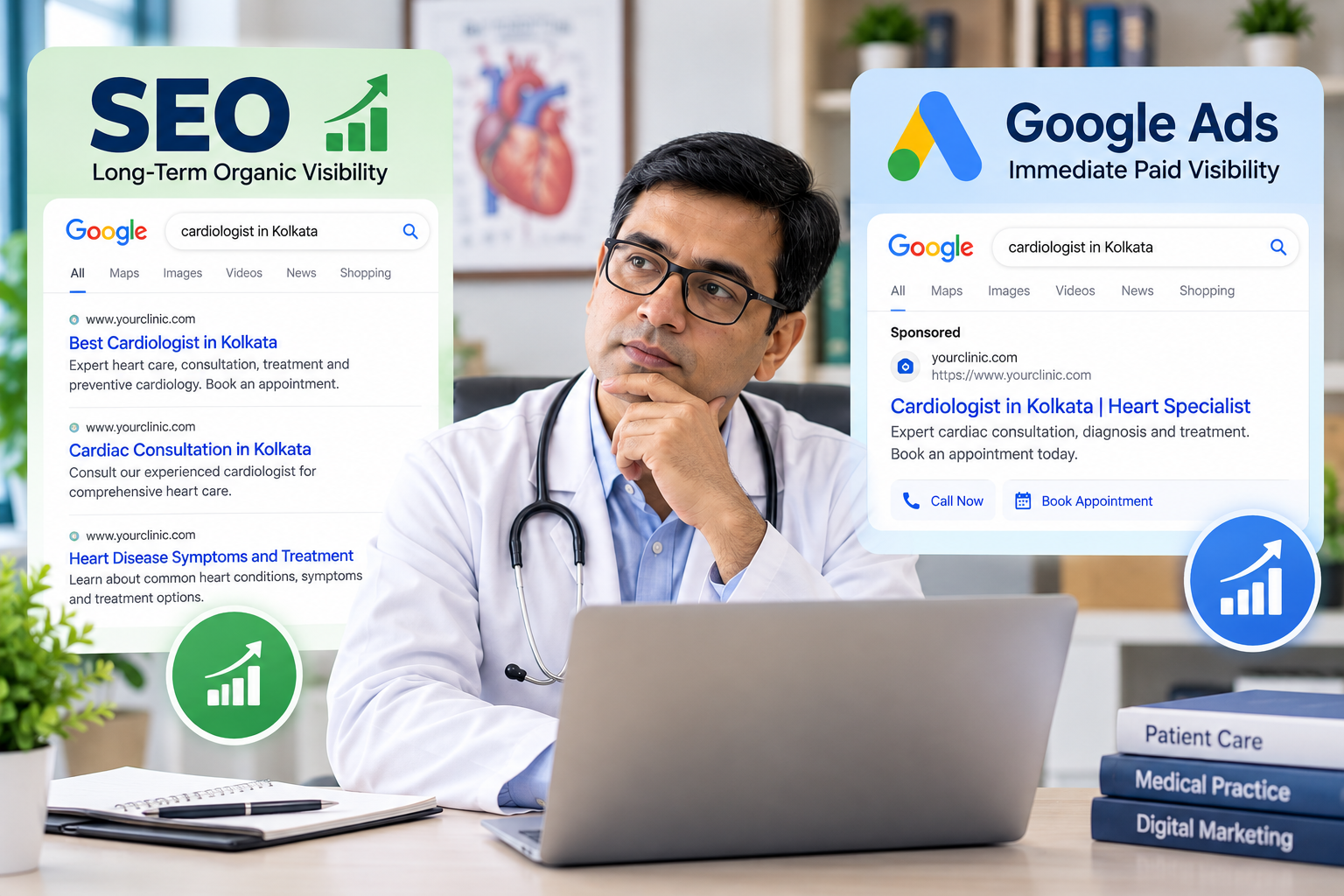
Imagine a patient in Kolkata searching for a cardiologist.
Google may show advertisements for relevant practices as well as organic search results. The paid advertisement gives a practice an opportunity to appear through advertising, while the organic result depends on Google's assessment of the website and its relevance to the search.
Google itself describes Search campaigns as a way to reach people who are actively searching for the products or services being advertised. Google Search campaign documentation
SEO takes a different route. Instead of paying Google to show an advertisement, the focus is on making the website useful, accessible, relevant and understandable so that its pages can compete for organic visibility.
Both can bring visitors to the same doctor's website, but the route is different.
When Google Ads can make sense for a doctor
Google Ads can be particularly useful when a doctor wants to capture existing search demand.
Consider searches such as:
- "fertility specialist in Kolkata"
- "cardiologist near me"
- "orthopaedic doctor Kolkata"
- "dentist in South Kolkata"
- "dermatologist for acne Kolkata"
These searches indicate that the person is actively looking for something. A Search campaign can be structured around relevant services and keywords so that the doctor's advertisement has an opportunity to appear for those searches.
That does not mean every search will produce a patient. The campaign still needs appropriate targeting, relevant advertisements, a useful landing page and proper conversion tracking.
Google recommends measuring conversions so advertisers can understand which actions are valuable rather than judging campaigns only by clicks. Google Ads conversion measurement guidance
When SEO can make more sense
SEO becomes particularly useful when a doctor wants to build organic visibility around a wider set of searches.
A medical practice may want to be found not only for the doctor's name, but also for:
- The doctor's specialty
- Individual treatments
- Medical conditions relevant to the practice
- Service-related searches
- Location-based searches
- Patient questions
- Doctor and clinic searches
Instead of sending all of those searches to one homepage, a properly structured website can have useful pages covering the doctor's specialty, services and relevant patient information.
This is one of the foundations of Medical SEO for Doctors in Kolkata .
Google Ads is faster, but the budget keeps running
One of the biggest differences between the two approaches is the relationship between visibility and spending.
With Google Ads, you set an advertising budget and your advertisements can participate in Google's advertising system according to your campaign settings. Once the campaign stops, the paid visibility associated with that campaign also stops.
That makes Google Ads useful when a doctor wants a controllable paid channel for generating traffic and enquiries.
But it also means the practice has an ongoing advertising expense.
The objective should therefore not be simply to generate clicks. The doctor needs to know whether those clicks are producing relevant enquiries, appointments and patients.
SEO takes longer, but builds an organic asset
SEO generally requires more patience.
A page has to be discovered, crawled, understood and evaluated by search engines. Competitive searches can take time to improve, particularly when a website is new or has limited authority and useful content.
There is no responsible way to promise a doctor that a page will reach a particular Google position within a fixed number of days.
But the advantage of successful organic SEO is that the website can build visibility across many relevant searches without paying Google for every organic click.
That does not mean SEO is free. Content development, technical work, optimisation, local SEO and ongoing monitoring all require investment.
What happens when a doctor has a limited budget?
This is where the decision becomes more practical.
Suppose a doctor has a limited monthly marketing budget and wants to promote one important service.
One possible approach is to use Google Ads to test whether there is sufficient search demand and whether relevant enquiries can be generated from that service.
At the same time, the doctor can build the website's organic foundation around the same specialty and related services.
This avoids treating SEO and Google Ads as completely separate worlds.
What if the doctor needs patients now?
If the immediate objective is to capture people already searching for a service, paid Search can be considered because Google allows Search campaigns to reach people actively searching for the services being advertised. Google Ads campaign guidance
However, the campaign still needs enough budget to gather meaningful data. A very small budget spread across too many specialties, locations and keywords can make it difficult to understand what is actually working.
A better approach can be to identify the services that matter most to the practice and build the campaign around them.
What if the doctor wants long-term Google visibility?
This is where SEO becomes increasingly important.
A doctor's website can gradually build content and relevance around the specialty instead of relying entirely on advertisements.
For example, a fertility specialist might build useful pages around fertility consultation, IVF, infertility treatment and related patient questions.
An orthopaedic practice might build useful content around knee problems, joint conditions, sports injuries and relevant treatments.
The exact subjects should come from the doctor's real expertise and services, not from an artificial list of keywords.
What about Google Maps?
There is another part of the equation that doctors should not ignore: local search.
A patient looking for a doctor may care about where the clinic is located just as much as the doctor's specialty.
Searches involving terms such as "near me", neighbourhood names or specific parts of Kolkata can therefore be important for local practices.
This is where Local SEO and Google Business Profile optimisation become part of the wider strategy.
Our Local SEO for Doctors in Kolkata service focuses on this part of the search journey.
SEO vs Google Ads: a practical comparison
| Factor | SEO | Google Ads |
|---|---|---|
| Visibility | Organic search results | Paid advertising placements |
| Speed | Usually takes time to build | Can provide paid visibility once campaigns are active |
| Ongoing cost | Requires continued SEO investment | Requires ongoing advertising spend for paid traffic |
| Search coverage | Can build visibility across many relevant pages and queries | Controlled through campaign targeting, keywords and settings |
| Best suited to | Long-term organic visibility | Capturing relevant paid search demand |
| Measurement | Organic impressions, clicks, rankings and enquiries | Clicks, conversions, conversion value and advertising cost |
Why the website matters to both
Whether a visitor arrives through an advertisement or organic search, the website still has to convince that person to take the next step.
A slow website, unclear service information or difficult appointment process can weaken both SEO and paid advertising performance.
A doctor should therefore think about the website as part of the patient acquisition system rather than as a separate technical project.
Our Doctor Website Development in Kolkata service focuses on creating healthcare websites around clear patient journeys, mobile usability and SEO-ready structure.
Should a doctor use SEO and Google Ads together?
In many cases, there is a logical reason to consider both.
Google Ads can be used to capture paid search demand while SEO works on the website's longer-term organic visibility.
The two channels can also provide useful information about what people are searching for.
For example, if a particular service repeatedly generates relevant enquiries through paid search, that may provide a useful signal when deciding which organic pages deserve attention.
At the same time, organic search can introduce patients to information and services that may not be covered by a paid campaign.
But don't measure both channels in exactly the same way
A common mistake is expecting SEO and Google Ads to produce identical reports.
A Google Ads campaign can be measured through advertising metrics such as clicks, conversions, conversion value and advertising cost. Google specifically recommends conversion tracking to understand which actions are valuable. Google Ads measurement guidance
SEO needs a different set of measurements.
You may want to monitor organic impressions, clicks, search queries, landing pages, indexing, visibility for important services and ultimately enquiries generated through organic traffic.
The final business question, however, remains similar: Is the channel helping the practice attract relevant patients?
What should a doctor choose first?
There is no single answer that applies to every doctor.
A new practice trying to generate immediate search visibility may have a different priority from an established specialist with a strong website but weak organic visibility.
A doctor with one high-value service may approach the problem differently from a multi-specialty clinic with several departments.
The decision should therefore start with four questions:
- What service do I want more patients for?
- How are potential patients currently searching for that service?
- Do I need immediate paid visibility or broader long-term visibility?
- Can my website convert the visitors I attract?
The answers will usually make the next step much clearer.
Where does doctor digital marketing fit in?
SEO and Google Ads are two important parts of a larger system.
A doctor's online presence may also involve Google Business Profile, reputation, website development, content, conversion tracking and patient communication.
That broader approach is covered in our Doctor Digital Marketing services in Kolkata .
Frequently Asked Questions
Is SEO better than Google Ads for doctors?
Neither is universally better. Google Ads and SEO serve different purposes. Google Ads provides paid visibility, while SEO focuses on organic visibility. The appropriate choice depends on the doctor's objectives, budget, competition, services and timeframe.
Can a doctor run Google Ads without SEO?
Yes. A doctor can run Google Ads without having a comprehensive SEO campaign. However, the website still needs to provide a good experience and clearly communicate the service being advertised.
Can SEO replace Google Ads?
SEO can reduce a practice's dependence on paid traffic over time if organic visibility grows, but it does not perform the same function as advertising. Some practices may benefit from using both channels.
How long does SEO take for a doctor?
There is no universal timeline. Competition, website history, content quality, technical condition, authority and the search terms being targeted can all affect progress. A responsible SEO strategy should measure improvement over time rather than promise a fixed ranking date.
Should a doctor advertise every medical service?
Not necessarily. It is often more useful to identify the services that are commercially and clinically important to the practice and build the strategy around those priorities.
Conclusion: Don't choose between SEO and Google Ads too early
The SEO-versus-Google-Ads debate can make it sound as though a doctor has to choose one channel and reject the other.
In reality, the better decision starts with the practice itself.
If the immediate objective is to capture people who are already searching for a particular service, Google Ads can provide a controlled paid route to that demand. If the objective is to build broader organic visibility around the doctor's specialty, services, questions and locations, SEO has an important role.
And when a practice has the budget and the right foundation, there is no reason to think of the two channels as competitors. Paid search can support immediate acquisition while SEO works on the website's longer-term visibility.
The important thing is not to chase traffic for its own sake.
A doctor does not need thousands of visitors who will never become patients. The objective is to build a search presence that connects the right patient with the right medical service and gives that person a clear reason and easy way to take the next step.
The right digital strategy is therefore not simply SEO or Google Ads. It is the combination of visibility, relevance, trust, a useful website and a measurable patient journey — with the right channel receiving the right investment at the right stage of the practice.