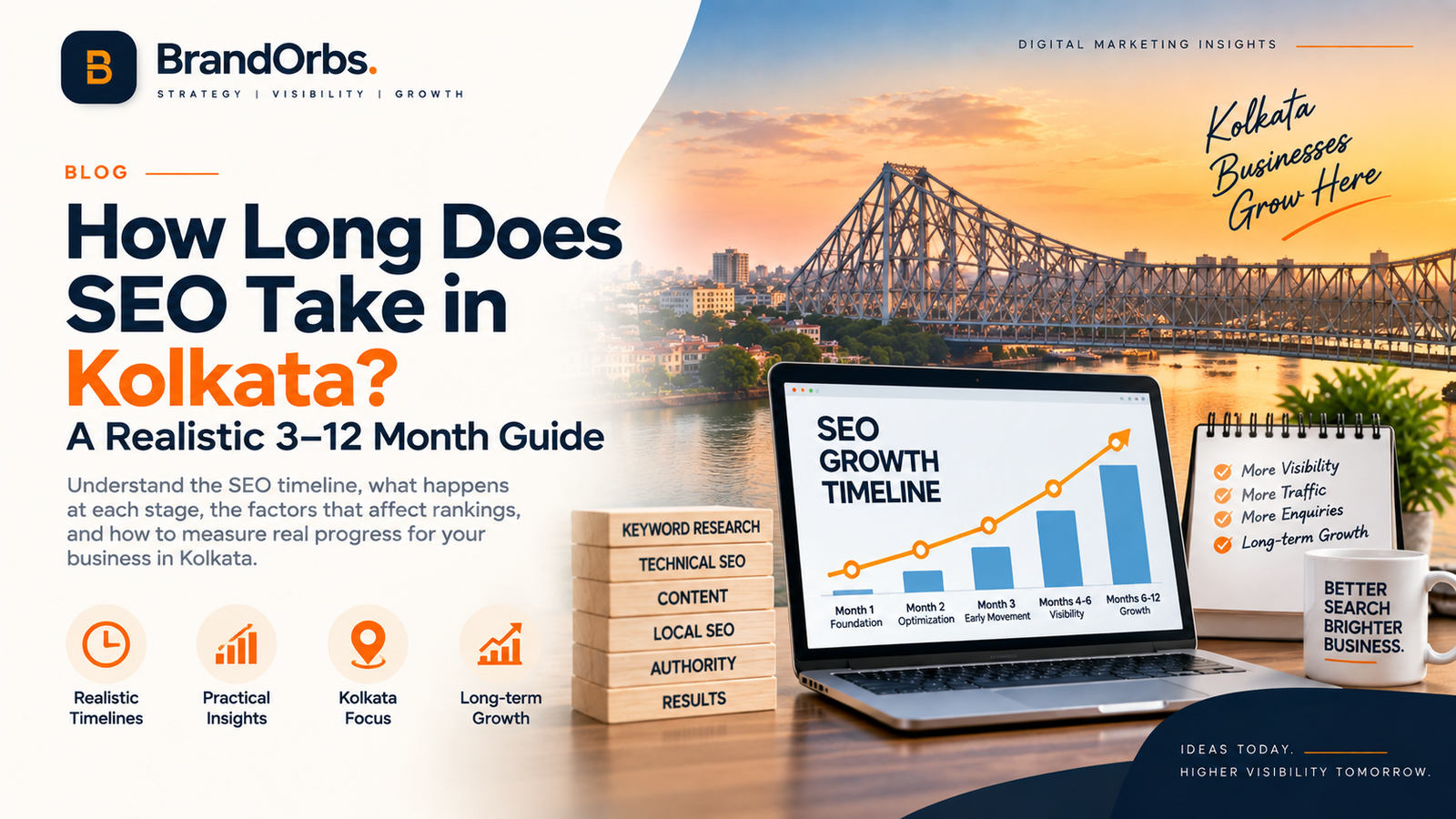
How Long Does SEO Take to Rank a Website in Kolkata?
One of the first questions almost every business owner asks before starting SEO is simple:
"How long will it take to rank my website on Google?"
If you are running a business in Kolkata, you may be wondering whether SEO can produce results in 30 days, three months, six months or even longer.
The honest answer is that there is no fixed SEO timeline that applies to every website.
Some websites begin showing keyword movement within a few weeks. Others need several months of technical improvements, content development, internal linking and authority building before significant organic growth becomes visible.
The timeline depends on factors such as your website's current condition, competition, content quality, website history, target keywords, location, authority and how consistently SEO work is implemented.
For a Kolkata business, local competition can also make a significant difference. Ranking for a highly competitive commercial search can require considerably more work than ranking for a specific service and location combination.
In this guide, we explain what a realistic SEO timeline can look like, what happens during each stage and how you should measure progress before expecting major Google rankings.
How Long Does SEO Usually Take?
For many businesses, meaningful SEO progress should be viewed over several months rather than several weeks.
A practical way to think about SEO is:
| Period | Typical Focus | What You May Start Seeing |
|---|---|---|
| Month 1 | Audit, research and technical improvements | Problems identified and initial improvements implemented |
| Month 2 | On-page SEO and content | Improved relevance and indexing of important pages |
| Month 3 | Content expansion and Local SEO | Early keyword movement and additional search visibility |
| Months 4–6 | Content, authority and continuous optimisation | More keywords may begin entering stronger positions |
| Months 6–12 | Expansion and refinement | Broader organic visibility and opportunities for competitive keywords |
This is a planning framework, not a ranking guarantee. A website can move faster or slower depending on its circumstances.
Why SEO Does Not Usually Work Like Google Ads
One reason businesses sometimes become frustrated with SEO is that they expect it to behave like paid advertising.
With Google Ads, a properly configured campaign can potentially begin receiving paid search traffic shortly after launch.
SEO works differently.
SEO involves improving a website and building its relevance and authority over time. Search engines need to discover, crawl and process changes, while the website also has to compete with other pages targeting similar searches.
That means SEO should generally be viewed as a long-term search visibility strategy, rather than a switch that immediately turns traffic on.
SEO Timeline: What Happens Month by Month?
Month 1: Website Audit, Research and Technical SEO
The first month should not simply be about publishing blog posts.
Before creating a large amount of new content, an SEO campaign should understand the current condition of the website.
This can include:
- Website audit
- Technical SEO checks
- Keyword research
- Competitor research
- Search intent analysis
- Indexing analysis
- Internal linking review
- Page title and meta description review
- Mobile usability checks
- Page speed review
For a website with technical problems, fixing the foundation can be more important than immediately creating dozens of new pages.
This is why a proper SEO campaign should begin with understanding where the website is today.
Month 2: On-Page SEO and Content Improvements
Once the main problems have been identified, the next stage is usually improving important pages.
This may include:
- Optimising service pages
- Improving page titles
- Improving headings
- Strengthening content
- Improving search intent alignment
- Adding relevant internal links
- Improving calls to action
- Creating supporting content
For example, if a Kolkata business wants to rank for several service-related searches, the website should have useful pages that clearly explain those services instead of trying to rank every keyword on the homepage.
You can see how our SEO Services approach covers technical, on-page, content and other areas of search optimisation.
Month 3: Content Growth and Local SEO
By the third month, the campaign can start expanding the website's topical coverage.
This can involve publishing useful supporting articles, improving internal links and strengthening local search signals.
For a local business, this is also a good stage to pay closer attention to Local SEO.
Local search optimisation can involve:
- Google Business Profile optimisation
- Local relevance
- Service and location pages
- Business information consistency
- Reviews and reputation signals
- Local content
- Internal links between service and location pages
The objective is not to create pages simply because a location keyword exists. Each page should provide useful information for people searching for that service in that location.
Months 4–6: Building Authority and Expanding Visibility
At this stage, an SEO campaign can have enough data to identify which pages and keyword themes are gaining traction.
The strategy can then be adjusted based on actual search performance.
Work may include:
- Improving pages already receiving impressions
- Expanding successful content topics
- Building relevant supporting content
- Strengthening internal linking
- Improving underperforming pages
- Developing authority-building activities
- Reviewing competitors again
- Optimising conversion paths
One important point is that SEO should not remain static.
If Google Search Console data shows that a page is receiving impressions for related searches but has a low click-through rate, the page may need a better title or description.
If a page is ranking around the second page for a valuable commercial search, additional content, better internal linking or other optimisation may be considered.
Months 6–12: Expansion and Continuous Optimisation
For businesses competing in more difficult markets, SEO can become a continuous process.
Once the website has established visibility for some search terms, the campaign can expand into additional keyword groups and topics.
This is where a website can move from targeting a small number of keywords to building topical authority around an entire service area.
For example, a business targeting SEO-related searches could build supporting content around:
- SEO pricing
- SEO timelines
- Local SEO
- Google Business Profile
- SEO audits
- SEO vs Google Ads
- Technical SEO
- AI search
- AEO
- GEO
Our article How Much Does SEO Cost in Kolkata in 2026? is one example of this approach, focusing on a specific question rather than publishing another broad "What is SEO?" article.
Why Some Websites Rank Faster Than Others
Two businesses can start SEO at the same time and experience very different results.
Here are some of the main reasons.
1. Keyword Competition
Not every keyword is equally difficult.
A specific local search may have relatively limited competition, while a broad commercial term can have many established websites competing for the same search.
The more competitive the search, the more work may be required.
2. Website History
An established website with years of useful content and existing search visibility is not starting from exactly the same position as a brand-new domain.
A new website may need time to establish its content structure, relevance and authority.
3. Technical SEO
A technically problematic website can slow down an SEO campaign.
Issues involving crawling, indexing, duplicate pages, broken links, canonicalisation or mobile usability may need to be addressed before other improvements can perform effectively.
4. Content Quality
Publishing more content does not automatically produce better rankings.
The content should answer the searcher's question, demonstrate useful knowledge and provide information that is relevant to the page's purpose.
This is particularly important now that search behaviour is changing and users can discover information through AI-powered search experiences.
Read our guide on How AI Search Is Changing SEO in 2026 to understand how this fits into modern search strategy.
5. Search Intent
Search intent matters.
Someone searching for:
"SEO cost in Kolkata"
has a different intention from someone searching for:
"what is SEO?"
A commercial search generally needs a page that satisfies commercial intent, while an informational search may require an educational resource.
Matching the right page to the right search intent is an important part of SEO.
6. Website Authority
Websites that have already earned relevant authority can have an advantage when competing for difficult searches.
Building authority is not simply about collecting a large number of links. Relevance, quality and the overall strength of the website matter.
How Long Does Local SEO Take in Kolkata?
Local SEO can show early improvements at different speeds depending on the business and competitive environment.
A business targeting a relatively specific local service may have a different timeline from a business competing for a highly searched service across Kolkata.
Local SEO can involve several areas at the same time:
- Google Business Profile
- Local landing pages
- Service pages
- Reviews
- Local relevance
- Website optimisation
- Internal linking
- Local citations and authority
For businesses dependent on enquiries from nearby customers, Local SEO should be considered alongside the broader organic SEO strategy.
Our Kalyani Mental Health Local SEO case study provides an example of a local healthcare search campaign.
How Long Does SEO Take for a New Website?
A new website usually has less history and fewer established search signals than an older website.
That does not mean a new website cannot rank.
However, a new website may need to establish:
- A clear website structure
- Useful service pages
- Relevant content
- Internal links
- Search engine accessibility
- Topical relevance
- Authority
- Trust signals
For this reason, businesses launching a new website should ideally consider SEO during the development stage rather than waiting until the website has already been published.
How Long Does SEO Take for an Existing Website?
An existing website can have a head start if it already has useful content, indexed pages, backlinks and established organic visibility.
However, an older website is not automatically an SEO-strong website.
It may contain outdated content, technical problems, poor internal linking or pages that no longer match search intent.
In some cases, an established website needs restructuring rather than simply adding more content.
Can SEO Rankings Improve in 30 Days?
Yes, keyword positions can change within a short period, but that should not be interpreted as a promise that a website will reach page one within 30 days.
Some low-competition searches may move relatively quickly after optimisation.
Other competitive keywords may require much longer.
The important distinction is between early movement and sustainable organic growth.
A professional SEO campaign should focus on building the foundations for continued improvement rather than chasing short-term ranking jumps.
Why SEO Agencies Should Not Guarantee #1 Rankings
If an SEO company promises that your website will definitely reach position one on Google within a specific number of days, you should ask how that promise is being measured.
Search results can vary according to competition, location, device, search intent, website changes and Google's ranking systems.
A more useful SEO conversation is about:
- Target keywords
- Organic impressions
- Organic clicks
- Ranking trends
- Qualified traffic
- Leads and enquiries
- Conversion rates
- Technical improvements
- Content growth
The goal should not simply be to report a ranking number. The goal should be to improve the website's ability to attract relevant visitors and business enquiries.
SEO vs Google Ads: Which Is Faster?
If speed is the main consideration, SEO and Google Ads should be understood as different channels.
| Factor | SEO | Google Ads |
|---|---|---|
| Traffic model | Organic | Paid |
| Initial visibility | Usually takes time to build | Can begin after campaign launch |
| Long-term objective | Build organic visibility | Capture paid search demand |
| Ongoing investment | SEO work and optimisation | Ad spend plus campaign management |
| Best suited for | Long-term organic growth | Businesses looking to capture paid demand |
For some businesses, combining SEO and Google Ads can make sense because the two channels can serve different stages of a marketing strategy.
How Should You Measure SEO Progress?
Waiting for a page to reach position one is not the best way to evaluate an SEO campaign.
There are several indicators you can monitor before reaching the desired ranking positions.
Organic Impressions
Impressions can show whether your website is appearing for more searches.
Organic Clicks
Clicks indicate whether search visibility is generating actual visits.
Keyword Visibility
Tracking a group of relevant keywords can help identify movement over time.
Indexed Pages
For larger websites, monitoring indexing can help identify whether important pages are being discovered and processed.
Organic Leads
For a business, traffic alone is not enough. Contact form submissions, calls, enquiries and other conversions can be more meaningful business metrics.
Conversion Rate
If organic traffic increases but visitors do not contact the business, the website may need conversion optimisation as well as SEO.
What If Rankings Are Not Improving?
If a website does not show the expected progress, the answer should not automatically be "publish more content."
The campaign should be reviewed.
Questions to investigate include:
- Are we targeting the right keywords?
- Does the page match search intent?
- Is Google indexing the page correctly?
- Is the content genuinely useful?
- Are competitors providing better answers?
- Does the website have sufficient topical coverage?
- Is the internal linking structure strong?
- Are technical issues holding the website back?
- Is the target keyword too competitive?
- Is the page receiving impressions but not clicks?
SEO should be treated as a process of testing, analysing and improving, rather than following the same checklist every month.
How SEO Content Builds Long-Term Visibility
One reason we recommend creating supporting content is that a single service page does not always answer every question a potential customer may have.
For example, a business searching for SEO services may also want to know:
- How much SEO costs
- How long SEO takes
- Whether SEO or Google Ads is better for their situation
- What an SEO agency actually does
- How Local SEO works
- How Google Business Profile optimisation works
- How SEO is changing because of AI search
Each useful article can address one of these questions and then link readers back to the main commercial service page.
This creates a connected SEO content cluster instead of a collection of unrelated blog posts.
SEO Case Studies Can Also Help Build Trust
When evaluating an SEO agency, businesses should look beyond promises and package descriptions.
Case studies can show how SEO was actually approached for a particular type of business.
Our NovoBarcode SEO case study demonstrates an SEO campaign for an e-commerce business operating in the barcode market.
For local healthcare search, our Kalyani Mental Health Local SEO case study shows another type of search optimisation challenge.
These examples also demonstrate why SEO timelines can differ from one business to another.
What Should an SEO Agency Do During the First Three Months?
If you are considering SEO for your Kolkata business, ask the agency what will actually happen during the first three months.
A sensible plan may include:
Month 1
- Website audit
- Competitor research
- Keyword research
- Technical SEO
- Initial on-page improvements
Month 2
- Service page optimisation
- Content development
- Internal linking
- Local SEO improvements
- Technical refinement
Month 3
- Supporting content
- Search performance analysis
- Further on-page optimisation
- Authority-building activities
- Strategy adjustments based on data
The exact activities should depend on the website rather than being treated as a universal three-month checklist.
Frequently Asked Questions
How long does SEO take to rank a website in Kolkata?
There is no fixed timeline. Some websites may show early keyword movement within weeks, while meaningful growth for competitive searches can require several months or longer. Competition, website condition, content, authority and search intent all influence the timeline.
Can SEO rank my website in one month?
Some less competitive searches may move quickly, but there is no reliable way to guarantee page-one rankings within one month. SEO should be evaluated over a longer period using visibility, traffic and business-conversion data.
How long does Local SEO take?
Local SEO timelines vary according to competition, business location, Google Business Profile strength, website quality, reviews, local relevance and the amount of optimisation being performed.
Is SEO better than Google Ads?
SEO and Google Ads serve different purposes. SEO focuses on organic visibility, while Google Ads provides paid search visibility. The appropriate channel depends on the business objective, timeline and available budget.
How long should I continue SEO?
SEO is generally better viewed as an ongoing marketing activity rather than a one-time task. Once a website gains visibility, competitors continue improving their websites, search behaviour changes and new opportunities appear.
What should I check before hiring an SEO agency?
Look at the proposed scope of work, technical SEO process, content strategy, keyword research, reporting, communication, Local SEO capability and relevant case studies. Avoid choosing an agency based only on the lowest monthly price.
Final Thoughts: SEO Is a Process, Not a Countdown
If you are asking "How long does SEO take?", the most useful answer is not a guaranteed number of days.
SEO is a process.
First, the website needs to be understood and technically prepared. Then important pages need to be improved. Content needs to be developed around real search intent. Internal links and topical relationships need to be strengthened. Local businesses may need stronger local search signals, while competitive websites may require broader authority-building work.
Over time, the data tells you what is working and what needs to change.
For some businesses, early improvements may appear quickly. For others, competitive keywords can require a much longer investment.
The better question is not "Can you guarantee page one in 30 days?"
It is:
"What are you going to improve, how will you measure it, and how will the strategy change as the data comes in?"
That is a much more realistic way to approach SEO in Kolkata in 2026.
Want to Know How Long SEO Could Take for Your Website?
Every website starts from a different position. A technical audit and competitor analysis can help identify the work required, the opportunities available and the factors that may affect your SEO timeline.
Request a Free SEO Audit