Hiring a Digital Marketing Agency in Kolkata: What Actually Happens After You Sign?
If you are considering hiring a digital marketing agency in Kolkata, the proposal is usually the easiest part of the process.
The harder question is what happens after you actually sign.
Who works on your account? What happens to your website? Where does the advertising money go? How much work is actually done every month? When should you expect results? What should appear in your monthly report? And what happens when the campaign does not perform as expected?
These are the questions business owners often ask only after they have already signed an agency contract.
This guide takes a different approach.
Instead of simply listing digital marketing services, we will look at the relationship from the business owner's side — from the first conversation and account access to strategy, SEO, Google Ads, social media, reporting, monthly meetings, costs, expectations and what happens when things do not go according to plan.
If you are comparing a digital marketing company in Kolkata, this is the part you should understand before comparing packages.
- What Does a Digital Marketing Agency in Kolkata Actually Do?
- Before Hiring an Agency: Do You Actually Need One?
- The First Meeting Is More Important Than the Proposal
- What Services Does a Digital Marketing Agency in Kolkata Provide?
- The Day You Give the Agency Access
- Step 1: The Agency Audits What You Already Have
- Step 2: Competitor Research
- Who Is Actually Working on Your Account?
- What Happens to Your First Month's Money?
- How Much Does a Digital Marketing Agency Cost in Kolkata?
- Month 1: What Should You Actually See?
- Month 2: The Agency Should Start Showing Its Thinking
- Month 3: What Did We Learn?
- Months 4–6: Continue, Improve or Change Direction?
- SEO: What Are You Really Paying For?
- Local SEO: Google Maps Is Only One Part of the Job
- Google Ads: Where Does the Advertising Money Go?
- Social Media: Are You Paying for Posts or Marketing?
What Does a Digital Marketing Agency in Kolkata Actually Do?
There is no single activity called "digital marketing".
An agency may work across several channels depending on what a business actually needs.
- Search Engine Optimisation (SEO)
- Local SEO
- Google Business Profile optimisation
- Google Ads
- Social Media Marketing
- Meta Ads
- Content Marketing
- Landing Page Optimisation
- Website Development
- Performance Marketing
- Analytics and Conversion Tracking
- Email and remarketing campaigns
But a business does not automatically need every service on this list.
A dental clinic may need Local SEO and Google Ads more urgently than a large social-media programme. An e-commerce company may need product-page SEO, paid search and conversion optimisation. A B2B company may need search visibility and high-intent content.
That is why a good conversation should begin with the business problem rather than a package.
The first question should not be "Which package do you want?"
It should be:
"How are customers finding you today, and where do you want more business from?"
Before Hiring an Agency: Do You Actually Need One?
This is an uncomfortable question for an agency to ask, but it is an important one.
Sometimes a business does not have a digital marketing problem.
It may have a website problem.
Or a tracking problem.
Or a sales follow-up problem.
Or simply an unclear offer.
For example, imagine a business receiving 50 enquiries every month but converting only two customers.
Buying another 50 leads may not solve the underlying problem.
Before spending more money, the agency and client should understand where the customer journey is breaking.
A useful way to think about the journey is:
Search → Click → Website → Enquiry → Qualified Lead → Appointment → Customer → Revenue
Different parts of this journey can require different solutions.
The First Meeting Is More Important Than the Proposal
A good first meeting should involve more questions than sales presentation.
The agency may want to know:
- What exactly do you sell?
- Which services or products are most profitable?
- Where are your customers located?
- Who is your ideal customer?
- What is the approximate value of a new customer?
- How do customers currently find you?
- Which competitors are getting attention?
- Have you previously run Google Ads?
- What happened with previous SEO work?
- How quickly are enquiries followed up?
- Who answers incoming calls?
- What happens after someone fills out your form?
These questions may seem unrelated to SEO or advertising.
They are not.
Suppose one service generates three times more revenue than another. That information should influence marketing priorities.
The agency cannot discover everything from Google Keyword Planner or an SEO tool.
The business owner knows things that the agency's software cannot tell it.
What Services Does a Digital Marketing Agency in Kolkata Provide?
A digital marketing agency in Kolkata may provide several different services, but the correct combination depends on the business, its customers, competition and budget.
- SEO: Improving organic search visibility and attracting relevant search traffic.
- Local SEO: Improving visibility for location-based searches and Google Maps.
- Google Ads: Managing paid search campaigns for targeted traffic and enquiries.
- Social Media Marketing: Planning and publishing content across relevant social channels.
- Performance Marketing: Managing campaigns around measurable traffic, leads or conversion objectives.
- Content Marketing: Creating useful pages and articles around customer questions and search intent.
- Landing Page Optimisation: Improving the pages used to convert advertising and organic traffic.
- Website Development: Building or improving the website that supports the marketing activity.
- Analytics and Tracking: Measuring what visitors and potential customers do.
For BrandOrbs, these services are available individually or as part of a broader strategy depending on the client's requirements.
You can explore our SEO Services, Local SEO, Google Ads, Social Media Marketing, Performance Marketing and Website Development services.
The Day You Give the Agency Access
After signing, one of the first practical steps is usually access.
Depending on the project, an agency may need access to:
- Website or CMS
- Google Search Console
- Google Analytics
- Google Tag Manager
- Google Ads
- Google Business Profile
- Meta Business Manager
- Facebook Page
- YouTube
- CRM or lead management system
But there is an important difference between access and ownership.
The business should understand who owns its website, advertising accounts, analytics data, domain and other important digital assets.
Before signing, ask a simple question:
"If we stop working together six months from now, do I still control my digital assets?"
Step 1: The Agency Audits What You Already Have
An agency should understand the existing situation before deciding what needs to change.
Depending on the project, this can involve checking:
- Website structure
- Indexation
- Existing organic rankings
- Search Console data
- Google Ads history
- Search terms
- Conversion tracking
- Google Business Profile
- Competitor visibility
- Landing pages
- Social accounts
The important question is not whether an agency has performed an audit.
The important question is:
"Did the audit change the strategy?"
If Google Ads is spending money on irrelevant searches, the first priority may be reducing wasted spend.
If the website receives traffic but visitors do not enquire, the first priority may be conversion improvement.
If an existing page already ranks well, unnecessary changes could potentially be more harmful than useful.
Step 2: Competitor Research
Competitor research should go beyond copying keywords.
An agency may investigate:
- Which competitors appear in Google
- Which pages attract organic visibility
- Which services they promote
- How their landing pages are structured
- How their Google Business Profiles are presented
- Review patterns
- Advertising activity
- Content topics
- Offers and calls to action
The purpose is not to reproduce a competitor's website.
It is to understand what a customer sees when comparing your business with alternatives.
Who Is Actually Working on Your Account?
This is something many clients do not ask before signing.
The person who sends your monthly report may not be the person doing your SEO.
A typical agency account can involve several roles:
| Role | Typical Responsibility |
|---|---|
| Account Manager | Communication, approvals, timelines and coordination. |
| Strategist | Overall direction, priorities and channel decisions. |
| SEO Specialist | Technical SEO, keywords, content, optimisation and organic performance. |
| Google Ads Specialist | Campaigns, search terms, keywords, ads, budgets and conversions. |
| Local SEO Specialist | Google Business Profile, local visibility, reviews and local optimisation. |
| Content Writer | Blogs, service pages, landing pages and other content. |
| Designer | Social creatives, advertising graphics and visual content. |
| Developer | Website, landing-page, technical and tracking implementation. |
What Happens to Your First Month's Money?
This is one of the most practical questions a new client can ask.
If you pay an agency ₹15,000 per month, that does not mean ₹15,000 is being spent directly on Google.
If you separately spend ₹40,000 on Google Ads, that is advertising expenditure rather than the agency's management fee.
A proposal should make the difference clear.
| Expense | Purpose |
|---|---|
| Agency fee | Strategy, management and execution. |
| Advertising spend | Money paid to advertising platforms. |
| Content | Writing and content production. |
| Creative | Design, graphics or video production. |
| Website work | Development or landing-page work. |
| Tools | SEO, analytics or other software where applicable. |
| Taxes | Applicable GST or other statutory charges. |

How Much Does a Digital Marketing Agency Cost in Kolkata?
There is no single standard price for digital marketing in Kolkata.
Pricing can vary according to the number of channels, competition, content requirements, advertising management, website work, locations, reporting and the amount of specialist involvement required.
A small business using one or two channels will have a very different requirement from an e-commerce company running SEO, Google Ads, social advertising, content and conversion optimisation simultaneously.
That is why comparing agencies only by monthly price can be misleading.
A better question is:
"What exactly am I getting for this fee, who is doing the work and how will performance be measured?"
For a deeper look specifically at SEO pricing, see our guide to SEO Cost in Kolkata in 2026.
Month 1: What Should You Actually See?
The first month can feel slow to a new client.
Some of the most important work may not be visually exciting.
It can involve:
- Auditing the website
- Checking analytics and tracking
- Researching competitors
- Mapping keywords
- Understanding search intent
- Building campaigns
- Fixing technical issues
- Planning content
- Establishing performance baselines
That does not mean the first month should produce nothing.
The client should be able to see what was investigated, what was changed and what the agency discovered.
Month 2: The Agency Should Start Showing Its Thinking
By the second month, the conversation should become more specific.
The agency should be able to explain things such as:
- Which search terms are producing useful traffic
- Which Google Ads searches are irrelevant
- Which landing pages need improvement
- Which services deserve more attention
- Which content is gaining visibility
- Which campaigns should be adjusted
The agency should not simply tell you what it did.
It should tell you what it learned.
Month 3: What Did We Learn?
By the third month, there may be enough information to conduct a more meaningful strategic review, depending on the channel and amount of data available.
The discussion should cover:
- What is working?
- What is not working?
- Where is money being wasted?
- Which pages deserve more attention?
- Which keywords matter commercially?
- Which advertisements are producing useful results?
- Are leads relevant?
- What should change next?
This is where digital marketing should become a feedback loop rather than a monthly checklist.
Months 4–6: Continue, Improve or Change Direction?
Later months should not simply repeat the first three months.
If something works, it may deserve more investment.
If something consistently fails after appropriate testing, it may need to change.
If a new opportunity appears, the strategy may need to expand.
Optimisation does not mean doing more work.
It means doing more of the work that is producing useful evidence and less of what is not.
SEO: What Are You Really Paying For?
When you pay for SEO, you are not buying a guaranteed Google position.
You are paying for research, strategy, implementation, measurement and ongoing optimisation intended to improve organic visibility.
Depending on the project, SEO work may include:
- Technical SEO
- Keyword research
- Search-intent research
- Competitor analysis
- On-page optimisation
- Content strategy
- Content creation
- Internal linking
- Structured data
- Indexation improvements
- Page-speed improvements
- Content updates
- Authority development
- Search Console analysis
- Conversion analysis
A new website may need more technical work. An established website may need more content expansion and authority development. A local business may need stronger local relevance.
Read more about our SEO services.
If you are wondering how long SEO normally takes, see How Long Does SEO Take in Kolkata?
Local SEO: Google Maps Is Only One Part of the Job
A local business may say, "I want better Google Maps rankings."
But Local SEO is not simply changing a Google Business Profile.
Depending on the business, the work may involve:
- Google Business Profile optimisation
- Business categories
- Services
- Business information
- Reviews
- Photos
- Local landing pages
- Local content
- Internal links
- Relevant citations
- Competitor research
- Website optimisation
- Call and enquiry tracking
Google explains that local results are primarily influenced by relevance, distance and prominence. That is why simply repeating a location name on a page is not a substitute for genuine local relevance.
Explore our Local SEO services.
You can also read Why Is My Google Maps Listing Not Getting Calls?.
Google Ads: Where Does the Advertising Money Go?
This is one of the first things a new client should understand.
Your Google Ads budget and agency fee are two different costs.
The Google Ads specialist may be responsible for:
- Keyword research
- Campaign architecture
- Ad groups
- Search ads
- Negative keywords
- Location targeting
- Bid strategy
- Budget allocation
- Search-term analysis
- Ad testing
- Conversion tracking
- Landing-page recommendations
Once a campaign is live, it should be reviewed rather than simply left running.
Search terms change. Competition changes. Costs change. Lead quality changes.
That is why Google Ads management is an ongoing process.
Learn more about Google Ads management.
If you are comparing SEO and paid search, read SEO vs Google Ads for Kolkata Businesses.
Social Media: Are You Paying for Posts or Marketing?
This is another useful question to ask.
If an agency promises 20 posts every month, ask:
Why 20?
Does the business actually need 20?
What is each post supposed to achieve?
Social media work can involve:
- Content strategy
- Creative direction
- Copywriting
- Design
- Reels
- Publishing
- Community management
- Paid promotion
- Audience analysis
- Performance measurement
Posting frequently is not automatically a marketing strategy.
Reach is not revenue.
Followers are not customers.
But awareness can still matter for businesses where customers need repeated exposure before making a decision.
The important thing is to understand the role social media is expected to play.
See our Social Media Marketing services.
Website and Landing Pages: The Part Marketing Cannot Ignore
Imagine paying for Google Ads and receiving hundreds of visitors.
Now imagine the landing page is difficult to use on a mobile phone.
Or the form does not work.
Or the phone number is difficult to find.
Or the page does not clearly explain the service.
The advertising campaign may be working.
The conversion journey is not.
That is why website and landing-page work can become part of the marketing strategy.
It may involve:
- Mobile usability
- Page speed
- Calls to action
- Forms
- Trust elements
- Service information
- Analytics
- Conversion tracking
When required, BrandOrbs also provides website development.
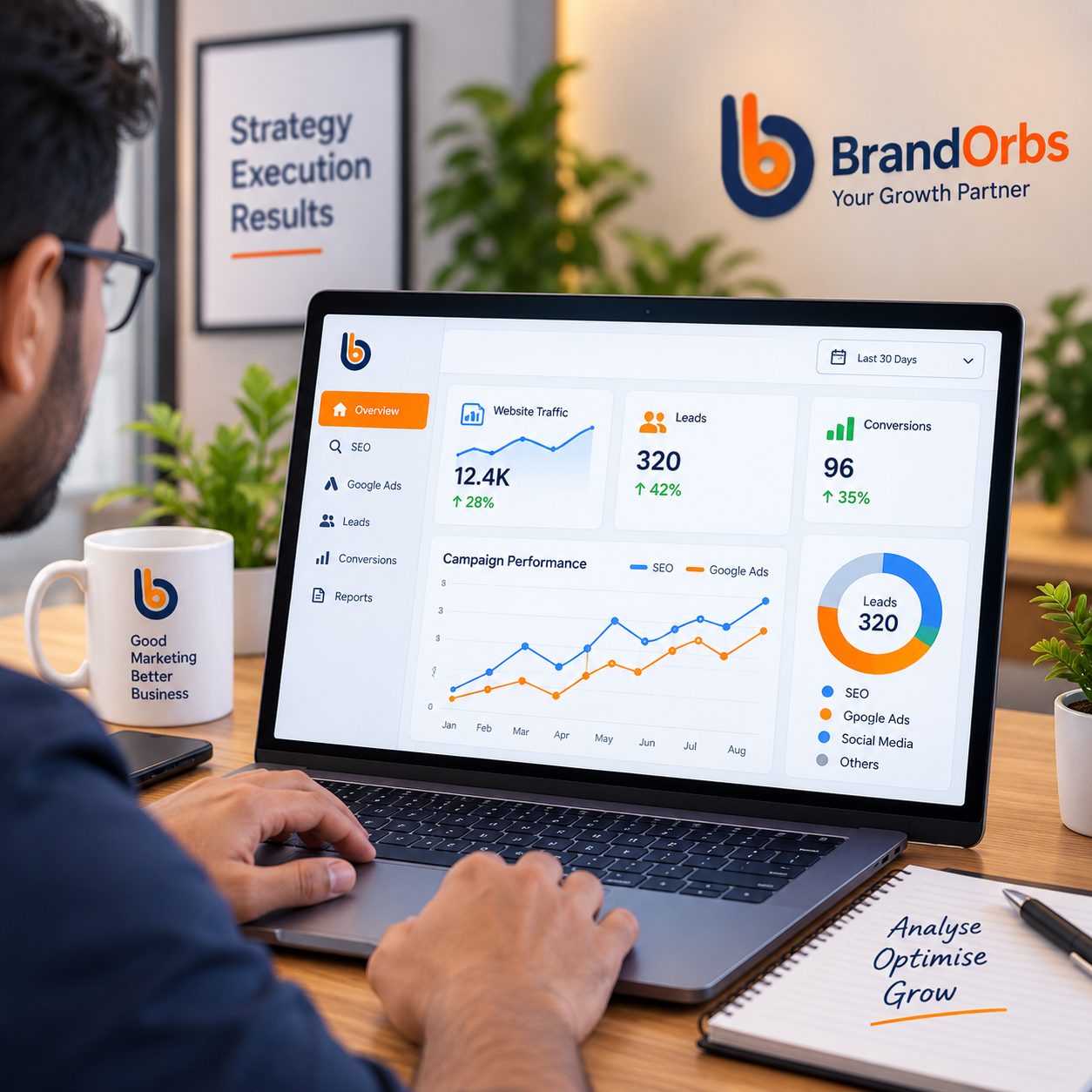
What Should a Digital Marketing Agency Report Every Month?
A monthly report can contain dozens of numbers and still answer almost nothing.
A useful report should help answer seven basic questions:
- What did you do?
- What happened?
- What improved?
- What declined?
- What did you learn?
- What are you changing?
- What do you need from me?
An SEO report may include:
- Organic clicks
- Impressions
- Important keyword movement
- Top-performing pages
- Technical work
- Content published
- Internal-link work
- Conversions where measurable
- Next priorities
A Google Ads report may include:
- Spend
- Clicks
- CTR
- CPC
- Conversions
- Cost per conversion
- Search-term findings
- Negative keywords
- Campaign performance
- Lead quality where available
The Monthly Meeting Should Not Be Someone Reading the Report
Imagine spending 45 minutes listening to someone read numbers that you can already see in a spreadsheet.
That is not particularly useful.
A better meeting should focus on decisions.
| Discussion | Question |
|---|---|
| Business update | What changed in the business? |
| Performance | What happened in marketing? |
| Completed work | What was changed? |
| Learning | What worked and what did not? |
| Strategy | What changes next? |
| Client input | What does the agency need from the client? |
The meeting should ideally end with decisions, not simply another report date.
What If the Campaign Is Not Working?
This is where the quality of the agency-client relationship becomes visible.
Suppose Google Ads is generating clicks but very few enquiries.
The immediate answer should not automatically be:
"Increase the budget."
First investigate:
- Are the keywords relevant?
- Are the search terms relevant?
- Are negative keywords missing?
- Does the advertisement match the search?
- Does the landing page answer the customer's question?
- Does the form work?
- Does the phone number work?
- Is conversion tracking accurate?
- Are leads being followed up properly?
The same principle applies to SEO.
If organic traffic increases but enquiries do not, the answer may not be "publish more content". The conversion journey needs to be investigated.
What If the Leads Are Coming but They Are Bad?
This is different from receiving no leads.
A campaign can generate a large number of enquiries and still disappoint the business.
Possible reasons include:
- Broad search intent
- Wrong locations
- Wrong audience
- Weak qualification
- Unclear service positioning
- Low-intent keywords
- People looking for information rather than buying
The agency should ask the client:
"Which of these leads would you actually want more of?"
That feedback can be extremely useful for campaign optimisation.
The Agency Cannot Control Everything
This needs to be understood by both sides.
An agency can generate a lead.
It cannot force the client to answer the phone.
It can improve a landing page.
It cannot control whether the sales team follows up.
It can optimise an advertisement.
It cannot control sudden changes in demand, competitor pricing or business decisions.
Digital marketing performance is therefore a shared system:
Agency + Client + Market + Offer + Sales Process
All of these can influence the final outcome.
What Should the Client Be Responsible For?
The client also has an important role.
The agency may need:
- Business information
- Approvals
- Product updates
- Offer information
- Images
- Service details
- Access
- Feedback
- Lead-quality information
- Sales feedback
If an agency asks for approval on Monday and receives it three weeks later, the campaign timeline naturally changes.
What Should the Agency Be Responsible For?
The exact scope should be written into the agreement.
Depending on the project, agency responsibilities may include:
- Strategy
- Research
- Execution
- Campaign management
- Content
- Optimisation
- Tracking
- Reporting
- Communication
- Recommendations
Do not rely on assumptions about what "digital marketing" includes.
What Should a Digital Marketing Agency Promise?
Be cautious when an agency promises a guaranteed:
- Google #1 ranking
- Exact number of leads
- Exact cost per lead
- Guaranteed sales
- Instant SEO results
- Viral social-media performance
A responsible agency can promise a process of research, execution, measurement and optimisation.
It should be more careful about guaranteeing a specific outcome controlled by multiple external factors.
When Should You Increase the Marketing Budget?
Increasing the budget should not automatically be the answer to weak performance.
First ask:
- Is the campaign producing conversions?
- Are the leads relevant?
- Is the sales team converting them?
- Are there profitable campaigns to scale?
- Is there enough search demand?
- Can the landing page handle additional traffic?
If the existing system is leaking money, adding more money can simply increase the size of the leak.
When Should You Reduce or Stop a Marketing Channel?
Stopping a channel is not automatically a marketing failure.
Sometimes it is simply a strategic decision.
A channel may deserve reconsideration when:
- The audience is wrong
- The economics do not work
- Testing has not improved performance
- Lead quality remains poor
- Another channel is producing stronger opportunities
- The business has changed direction
The important thing is to make the decision using evidence rather than emotion.
Account Ownership: One Question Every Client Should Ask
Before signing, ask:
"If we stop working together tomorrow, what happens to my accounts and data?"
Clarify ownership of:
- Domain
- Hosting
- Website
- Google Ads
- Google Analytics
- Search Console
- Google Tag Manager
- Google Business Profile
- Meta Business Manager
- Facebook Page
- Creative files
- Content
The agency needs access to perform its job.
That does not automatically mean the agency should own the business's core digital assets.
What Happens If You Leave the Agency?
This should be discussed before the relationship starts.
Ask about:
- Notice period
- Outstanding fees
- Account access
- Website access
- Creative files
- Content ownership
- Reporting history
- Campaign history
- Handover process
A professional marketing relationship should have a clear exit process.
How Do You Know Whether Your Digital Marketing Agency Is Actually Working?
Do not judge an agency only by the number of tasks completed.
Ask questions such as:
What did you change because of last month's data?
Which part of the campaign are you stopping?
Which area are you increasing?
Which searches are producing the best enquiries?
Which landing page converts better?
What problem did you discover this month?
What are you testing next?
If the agency can answer these questions clearly, you are discussing management rather than simply activity.
How to Choose a Digital Marketing Agency in Kolkata
Before signing a contract, ask these questions:
- Who will actually work on my account?
- What exactly is included?
- What is excluded?
- Is advertising spend separate?
- Who owns the advertising account?
- Who owns the website?
- What tracking will be installed?
- What will the monthly report show?
- How often will we communicate?
- What happens if performance is poor?
- What do you need from me?
- What should I realistically expect during the first 90 days?
- What happens if we stop working together?
If the answers are vague before signing, they are unlikely to become clearer after signing.
What Should You Expect From Your First 90 Days?
The first 90 days should generally be viewed as a period of understanding, implementation, measurement and learning, rather than simply a countdown to a promised ranking.
The exact experience varies by channel.
For SEO, the early period may involve technical improvements, keyword research, content planning and optimisation.
For Google Ads, campaigns can begin generating data once tracking and campaigns are properly configured, allowing the agency to analyse search terms, advertisements, conversions and lead quality.
For Local SEO, the agency may work on the Business Profile, website relevance, local content and other location signals.
By the end of the initial period, the most useful question is not simply:
"Are we number one?"
It is:
"What have we learned, what has improved, and what should we do next?"
For a separate SEO timeline discussion, read How Long Does SEO Take in Kolkata?.
How BrandOrbs Approaches the Client Relationship
At BrandOrbs, the objective is to start with the business problem rather than simply push a pre-selected package.
Depending on the project, the process can involve:
Business Understanding → Audit → Competitor Research → Buyer Intent → Strategy → Setup → Execution → Measurement → Optimisation → Reporting → Review
The exact mix depends on the client's business and goals.
For one business, the priority may be SEO.
For another, Google Ads may be the faster acquisition channel.
For a local business, Google Maps visibility may be important.
For another company, the website may need improvement before more traffic is purchased.
The objective is to build a marketing system that can be measured and improved rather than simply increasing the number of activities completed each month.
A Simple Example: A Kolkata Business Starts With a New Agency
Imagine a local business approaches an agency because enquiries have fallen.
The owner initially thinks:
"We need more Google Ads."
The agency audits the situation.
It discovers that:
- The website is difficult to use on mobile.
- The main service page is weak.
- Google Ads contains irrelevant searches.
- Conversion tracking is incomplete.
- The Google Business Profile has outdated information.
- Some leads are not being followed up quickly.
Suddenly, "more Google Ads" is no longer the entire solution.
The strategy may instead become:
Tracking → Landing Page → Google Ads Cleanup → Local SEO → Lead Follow-up
This is why an audit matters.
The client's first idea is not always the actual marketing problem.
The Difference Between Activity and Performance
| Activity | Better Question |
|---|---|
| Published 10 blogs | Did the content attract relevant search visibility? |
| Created 20 social posts | Did the content support the business objective? |
| Generated thousands of clicks | How many useful conversions resulted? |
| Generated 100 leads | How many were qualified? |
| Increased traffic | Did enquiries or business value improve? |
Marketing activities matter.
But activities should eventually connect to a business objective.
Frequently Asked Questions About Digital Marketing Agencies in Kolkata
How much does a digital marketing agency in Kolkata charge?
There is no single standard fee. Pricing depends on the services involved, advertising management, content requirements, website work, competition, number of locations and the amount of strategic and execution support required.
What does a digital marketing agency do?
A digital marketing agency can plan, execute, measure and optimise online marketing activities such as SEO, Local SEO, Google Ads, social media, content marketing, website development and performance marketing.
How long does digital marketing take to produce results?
The timeline depends on the channel and starting point. Paid advertising can produce data soon after a correctly configured campaign launches, while SEO generally requires more time for technical improvements, content, authority and organic visibility to develop.
Should a small business hire a digital marketing agency?
It depends on whether the business has a clear marketing requirement that it cannot efficiently handle internally. A small business may not need every digital marketing service.
Is Google Ads better than SEO?
They solve different problems. Google Ads provides paid visibility while campaigns are active, whereas SEO aims to build organic visibility over time. Some businesses use both depending on budget, competition, search demand and acquisition goals.
What should I ask a digital marketing agency before hiring them?
Ask who will work on your account, what is included, what is excluded, how reporting works, who owns your advertising and analytics accounts, how success will be measured, what the agency needs from you and what happens if the relationship ends.
Should the agency own my Google Ads account?
Before signing, clarify account ownership and administrative access. Businesses should understand who controls their advertising, analytics, website and other important digital assets.
How do I know if my digital marketing agency is doing good work?
Look beyond the number of tasks completed. Ask what changed because of the previous month's data, what was learned, what is being improved, which activities are being reduced and what the next priorities are.
Final A-to-Z Checklist for Business Owners
- A — Audit: Understand the current situation.
- B — Buyer Intent: Know what customers are actually searching for.
- C — Competitors: Understand the market.
- D — Data: Establish a baseline.
- E — Execution: Implement the agreed strategy.
- F — Funnel: Track the journey from visitor to customer.
- G — Goals: Define what success means.
- H — Handover: Keep ownership and access clear.
- I — Internal Linking: Connect relevant content.
- J — Journey: Understand the customer path.
- K — Keywords: Target meaningful search intent.
- L — Landing Pages: Make conversion easy.
- M — Measurement: Track meaningful actions.
- N — Negative Keywords: Reduce irrelevant paid searches.
- O — Optimisation: Improve based on evidence.
- P — Performance: Look beyond activity.
- Q — Qualification: Separate leads from useful leads.
- R — Reporting: Understand what changed.
- S — Strategy: Know what happens next.
- T — Tracking: Make sure conversions are measurable.
- U — User Experience: Remove unnecessary friction.
- V — Visibility: Reach the right audience.
- W — Website: Make the website support the campaign.
- X — Experimentation: Test rather than assume.
- Y — Year-round Optimisation: Keep improving.
- Z — Zero Guesswork: Use evidence wherever possible.
Conclusion: You Are Not Really Hiring "SEO" or "Google Ads"
When a business hires a digital marketing agency, it is not really buying a collection of activities.
It is hiring people to make a series of marketing decisions on its behalf.
Which customers should we target?
Which services should receive attention?
Which searches matter?
Where should the advertising budget go?
Which page needs improvement?
What content should be created?
Which campaign should be stopped?
What did we learn this month?
What should happen next month?
That is the real work behind digital marketing.
A good agency relationship should therefore be more than:
"You pay us every month and we send you a report."
It should be:
"We understand your business, show you what we are doing, measure what happens, explain what is not working and change the plan when the evidence says we should."
That is the standard a business owner should look for when choosing a digital marketing agency in Kolkata.
Looking for a Digital Marketing Agency in Kolkata?
Before choosing a package, let us understand your business, target market, current digital presence and marketing goals.
BrandOrbs works with businesses on SEO, Local SEO, Google Ads, social media, performance marketing and website development.